Saturday, November 22, 2008

The Family as Sub-Contractor for the State

One point I keep on trying to pound home is that political debate in the USA is often fundamentally distorted by an ignorance of what the our history actually was. I would like to extend this argument to family policy.

Today we have two points of view on the family and the state. Both assume that the family and the state as autonomous organizations are opposed: a strong, purposeful state means a weak, passive family and vice versa. Liberals think the state should exercise stronger, more purposeful collective powers over citizens for their own good, but that the family should have less strong, purposeful collective powers over its members for their own good. Conservatives (especially paleo-conservatives and religious libertarians) think the state should exercise weaker, less purposeful collective power over citizens for their own good, but that the family should have stronger, more purposeful collective powers over its members for their own good. Strong state, weak family or strong family, weak state. Either/or.

Going along with this assumption of antagonism is a false view of history. Liberal historians look for evidence that the state has traditionally had more powers to regulate families than we think, thinking that this would prove that the autonomous family has weak historical roots. Likewise, conservative historians like to emphasize how even state powers over the family we now take for granted didn’t used to exist in the part, thinking that this would emphasize how families resisting interference from the state is an old, old tradition.

For Eurasian societies as widely distributed as Puritan New England, Württemberg peasants from the seventeenth to nineteenth centuries, and Mongolian and Tibetan nomadic societies*, however, either way of understanding state-family relations was alien. Rather than real family-state praxis, the conventional opposition of family and state reflects only crude and unreflective 19th century post-French Revolution social theories, the phlogistons of social theory. And even today, I think this old praxis survives, despite having no articulation, since the liberal and conservative intellectuals are still divided into "let's have more/less phlogiston!" parties.

In this different praxis the traditional family is itself a sub-contractor of the state (or if you prefer, the community as a whole). As a sub-contracting organization of the state-community, the family is represented by its head. It has a responsibility for producing a number of things for the state: as a rule taxes, in some states trained and equipped soldiers, for some families responsible officials, and in every case, children who will be able to play the contractor role in the next generation. In the Greek city states, performance of such public functions by private families were called "liturgies." Depending on the type of society, this might also involve making sure the children are equipped by literacy to respond to community admonitions (texts, government decrees, scriptures, etc.) It will in any case require that children be trained in the appropriate moral code to be hard-working, responsible contractors themselves. Since the family as a contracting unit for the state/community has a duty to produce both specific persons (soldiers, officials, corvee laborers, as the case may be), and future contractors, unwillingness to procreate is a selfish betrayal of the community/state.

In order to make sure that the sub-contractor can do its job, the state also parcels out to the family a significant chunk of its own authority, entrusting certain police and juridical functions to the heads of the households over the members (and to elders over juniors generally). The head of the family that acts to some degree as an agent of the state’s authority, even as he (or sometimes she, as a widow) resides on his ancestral patrimony. This patrimony is itself a fund for the performance of contracted obligations to the state.

The state/community’s interest in the family is therefore in keeping the sub-contractors functioning. One essential precondition of this is that the family has to have its own resources. The family has to have a sufficient fund of resources, tangible and intangible, to work with to produce the outputs it needs. A family with no land and no skills cannot fulfill its tax obligations. For that reason bad management, such as drinking one’s patrimony away, breaking it up with an irresponsible divorce, and so on, should not be tolerated. And if a family falls into that situation, it needs to have property restored and disciplined so this doesn’t happen again. Moreover, since only a family can produce the necessary outputs demanded by the community, individuals who are without family need to be put into a family.

Social policy in this "family as sub-contractor for the state" assumes a peculiar cast which the liberal-conservative point of view today is almost guaranteed to misunderstand. In it, what looks like charity is simultaneously fiscality: the state gives aid not just to help the individuals involved, but also to get the family receiving the aid back on its feet as a tax-paying/soldier-supplying/official-providing contracting unit. Equality is thus not just, or even primarily, a goal of such assistance, but rather a means to an end: the maximum possible effective provision of necessary persons/goods for the state and community. This is so even when the primary way of supplying such aid is not directly state to family, but lateral: neighbor to neighbor, or even structured by kinship (redemption right of land that might be sold to strangers). For example in the Secret History of the Mongols, we read that the emperor Ögedei ordered one sheep out of a hundred taken from each person and given to the poor in his own unit. This was in part to "let them put their feet on the soil and their hands on the land" but was just as much connected with the periodic renumbering of militiamen in the Mongol army to make sure that each unit had enough prosperous families to supply its share of taxes and soldiers. Among Tibetan pastoralists, Rinzin Thargyal describes how one ambitious lord encouraged the formation of functioning households. When a girl got "knocked up," he would pressure the man responsible into marrying her, loan the new family animals to herd, and hold off on demanding labor service from them until they were a going concern. He did the same with poor immigrants arriving in his estate: find them a wife or husband as needed, loan them animals, and get them going. As a result his estate was unusually prosperous, and his population -- and influence -- grew rapidly. In these cases, charity merges with the aim to preserve family units as sub-contractors of the state. Note also that almost all such societies also had distinctions of families: some produced taxes, others produced soldiers, others produced officials, and these status distinctions are maintained as part of the same system imperatives that forces one family of tax payers to give aid to another family of tax payers facing the danger of break-up and dispersal. In the Tibetan case, for example, the aristocratic household so actively building up its followings' families itself had to supply officials to the Dege principality.

A very common way to maintain households facing crisis is through redemption laws, specifying that households sell their property it may be redeemed from the buyer by a relative or neighbor of the seller. Redemption within the collateral family line, as found in the Mosaic laws in the Bible, is quite common comparatively, and can be found in eighteenth century Germany, as well as Qing dynasty China. Usually interpreted solely as part of compassion for the “poor” (although structurally at least the real poor in ancient Israelite society were not the full-blooded Israelites who had fields subject to such redemption, but the strangers and aliens who did not), this collateral redemption was actually an important part of fiscality (state tax policy) as were the limitations on mobility (in a weak state apparatus, staying in one place so the state can find you is important). Theologically as Christopher H. Wright in God's People in God's Land has pointed out, this works as an analogy: just as earthly kings demand a regimes of sub-contractor families, so the divine King demands a regime of sub-contractor families. Traditional sociological interpretation of this practice/ideal in the context Israelite history has usually read this as a survival of primitive tribalism, resisting the imposition of royal tyranny. In this comparative context, however, I think a better argument could be made that the importance of redemption indicates not "tribalism" but a strong state/community interest in preserving a network of effective sub-contracting and tax-paying militia families.**

Inversely, the elimination of the redemption regime (which took place in Würtemburg for example in the early nineteenth century or in China under the Republic) is not the state going from “respecting intermediate institutions” to “rejecting intermediate institutions” as the libertarian reading of state-family relations would have it, but rather sub-contracting with different units and different calculations. Similarly the family receiving moral guidance and tutelage from the state is not necessarily toxic to family authority—if the state is actually interested in buttressing that authority.

What are some of the implications of this history?

First of all, it helps understand what people are talking about. It is, I think, exactly this sense which is still meant when people, trying to explain why they find the challenge to the traditional constituted family so wrong-headed, say that the family is "the building block" or "foundation" of the country. Not having got the paleo-conservative/social democratic memo that the family and state are inverses -- one can't be a strong institution without the other being weak -- they insist on appealing to real social praxis, rather than the delusions of the political philosophies.

Second of all it points out again how very un-libertarian our Eurasian traditions are. And as Jim has written here, in common law it was taken for granted until the twentieth century that the US state governments had police powers, that is, the right to interfere more or less at will in the life of its members to defend good morals, tax paying capacity, optimal family structure, and so on. In this view, which was the Puritan New England view as David Hackett Fischer emphasized, the state as a sovereign community was, absent any self-limitation, virtually universal in its competence. However, in practice, specific liberties are carved out from this sovereign power and assigned to subcontracting units, such as the family, guild, township, or trading corporation, or what have you. Liberties are thus in the plural, and each one has to be defended either by a specific historical charter, or at least by specific evidence that it existed in the past. Note that it is for this reason that Puritans could join the US constitution. Strong believers in this police power and families as contractors of the state, they could never have joined a constitution that either eliminated these police powers entirely, or assigned them to a non-Congregational government. Only a government that had special liberties above the state (in both senses) could be accepted as the national government.

Thirdly it highlights how many traditional institutions have been misunderstood by a state vs. society framework. This misunderstanding takes the specific form of a what I call “the great inversion” in which institutions first nurtured by the pre-modern state came under attack in the nineteenth and twentieth century, whether by liberals as blocks to the free circulation of resources in the market or by socialists as buttresses of inequality, but then were rewritten by their defenders. This rewriting of history turned them into pre-state, primitive society institutions that had always served as bulwarks of "the people" against the state. The classic case of this is the obshchina or Russian commune, which began as a tax-guarantee institution: the village owed taxes in common and each family was assigned labor to make sure that each family thus contributed to the tax payments. In the 1840s, an idealistic German, looking for remnants of early communes in Europe's countryside reinterpreted this state-generated institution as such a survival of pre-class society. This interpretation was accepted, written in Russian law in 1861, and became the foundation of the populist idea of the Russian peasants being instinctively socialist and communal.***

In American, as well, this happened very early on with gun rights as shown by Joyce Malcolm’s To Keep and Bear Arms started not as an individual right against the state, but a collective sub-contractual obligation of citizens to the state. The English state required all men to participate in its function of maintaining order, training in long bows so the king of England could have enough soldiers in wartime. With the advent of firearms, this obligation to train as a potential soldier of the king was transferred to from long bows to firearms. In the seventeenth century, this hazardous duty was reinterpreted as a valuable right, and in this form was transported to the American colonies. (Although with the New England Puritans, gun ownership was also requirement of community self-defense, not an aspect of individual defiance of the community. Here, as in so many other aspects the New England Puritans typify the phenomenon of "peripheral preservation" where archaic customs and ideas are preserved in remote, provincial areas.)

Finally, the most important implication is for those adhering to the traditional family as valorized by the laws of the Eurasian religions whether Jewish, Christian, Muslim, Hindu, or Confucian. Despite their differences, I would argue that virtually every feature of the laws -- indeed the very possibility of having a law of family formation and functioning -- was shaped by the family's role as a sub-contractor of the state’s authority. Adherents of these Christian, Jewish, Muslim, Hindu, or Confucian ethics have to recognize that strong family they love became a social reality only in concurrence with state power and through receiving as a sub-contractor a share in the power of the state. The implication is then that the state, in a fairly strong sense, is a precondition for the traditional religious family life. For those adhering to such traditional religious family ethics, the libertarian argument that the state is thus at best a necessary evil runs directly against the historical facts, since those family ethics themselves were first realized in human society as a result of the existence of the state. The predicating of the family's rights on opposition to the state, as in religious libertarianism or paleo-conservatism, is likely to be as ineffectual politically as it is erroneous historically.

*Some sources on this:
New England Puritans: Albion's Seed, by David Hackett Fischer
Württemberg peasants: David Sabean, Production, Property and Family in Neckerhausen, 1700-1870.
Tibetan pastoralists: Rinzin Thargyal, Nomads of Eastern Tibet.

** Maybe more an ideal than a reality. That redemption laws might exist without having much of an anti-market effect is indicated at least by the Neckerhausen evidence as read by Sabean.

***See T.K. Dennison and A.W. Carus, "The Invention of the Russian Rural Commune: Haxthausen and the Evidence," The Historical Review 46.3 (2003), pp. 561-82.

Labels: , , , , , , ,

|

Friday, May 23, 2008

Actually Existing Complementarianism

Imagine someone who said to you: "I used to believe that premarital sex was just wrong. Then my daughter started dating and got pregnant. Since then our family has been completely overturned, and my Christian life devastated. As a result of all these troubles, I've realized all that stuff about premarital sex being against God's plan for families is just wrong." If you are like me, you'd think the logic was a bit strange. Isn't the trouble that follows from breaking the law you used to believe in normally seen as confirmation of the law's justice? I mean when violating some rule makes for unhappiness all around, we conclude that the rule might make sense. But if the person saying the opposite seems otherwise intelligent, we might assume that there is something else there, some hidden assumption going unexpressed, that makes the logic make sense. And if scores of other people agreed with the person when he said that, we might conclude that these hidden assumptions are actually widely shared. And that would be so even if those assumptions contradict the explicit theology of those persons.

I am thinking about the iMonk's recent post on his agony attendant upon his wife, Denise, becoming a Catholic (he's a Southern Baptist pastor). I would link to it, but it seems to have been removed by him from his site. I don't want to talk about the personalities and rights and wrongs of it all, but as I remember the post, it did have something of the shape: "I used to believe in a man's spiritual leadership in the home; my wife has rejected my spiritual leadership; my life and family are now in complete chaos; so I realize how wrong I was ever to believe in a man's spiritual leadership in the home." Now since this makes no sense at all logically and since the iMonk is certainly an intelligent person, it's clear that there are some hidden assumptions going unexpressed. And I am going to tell you what they are, and why they are there. And I'll start off by saying that those hidden assumptions are not his, but his quite accurate understanding of the sub-text of what "complementarianism"* means in churches that practice it.

Now, in theory "complementarianism" means something like this: "God has given to men a duty to exercise leadership (especially religious leadership) in the home and in the church." Corollaries include the idea that violation of this cause trouble, and so on. Let's call this "theoretical complementarianism."

But that is not all that "complementarianism" means, and not even the main part. It is certainly not the proposition that the iMonk saw completely shattered by his last year as his wife prepared to convert to Catholicism. Rather what was shattered is a quite different proposition: "When men exercise spiritual leadership in the home and church, women will inevitably welcome and follow this leadership." This would have the corollary that "If women deny male headship in church or home, it is all the fault of the men over them." You could also phrase it as "When men exercise spiritual leadership in the home and church, God hears their prayers and makes those who should follow, do so." Practically the result is the same: where men lead rightly women do, in fact and practice, follow. Let's call this proposition "actually existing complementarianism."

Now this would certainly be shattered by the iMonk's experience. He thought he was a good husband and good Baptist pastor -- and now his wife is rejecting his spiritual headship by becoming Catholic. So he now has two alternatives: 1) continue to accept actually existing "complementarianism" (as opposed to the theoretical version in the paragraph above) and take the blame as the bad husband and bad pastor whose failures drove his wife into Catholicism, and prevented God from responding to his desperate prayers; or 2) reject actually existing complementarianism. Now if theoretical complementarianism has been firmly enough linked to actually existing complementarianism, then rejecting the second will mean rejecting the first.

Now, what is the relationship between these two propositions? It certainly isn't some kind of logical corollary. Let's take an analogy: "God had ordained civil authorities as enforcers of the law and all citizens should obey" and "If civil authorities properly enforce the law, all citizens will obey" are independent propositions. None thinks the second follows from the first as some kind of automatic corollary. Likewise, the idea that good parents, for example, never get grief from teenage kids is not part of usual Christian teaching. So how did the Southern Baptist Church, and other churches teaching the same, get from one to the other in the case of husbands and wives?

Even stranger is that "actually existing complementarianism," despite being taught in Christian churches, seems to contradict Christian teachings about human nature. For example, original sin. How can we believe that an original sinner pastor/husband could ever exercise leadership well enough that "actually existing complementarianism" could be anything other than a purely theoretical issue? And how can we believe that even if the pastor/husband is perfect, an original sinner wife/congregant would inevitably welcome this leadership? I mean, does the Bible really teach that when prophets and priests lead in God's way that people always and inevitably follow? In fact, "actually existing complementarianism" is simply an assertion that both men and women can and will fulfill the law of theoretical complementarianism.

Actually existing complementarianism looks very much like Mencius; you know, the Confucian philosopher who argued that human nature is inherently good. Mencius was asked how a prince should get the common people to observe proper ritual. The answer? Just lead and the people will inevitably follow:

The prince said again to Ran Yu, 'Hitherto, I have not given myself to the pursuit of learning, but have found my pleasure in horsemanship and sword-exercise, and now I don't come up to the wishes of my aged relatives and the officers. I am afraid I may not be able to discharge my duty in the great business that I have entered on; do you again consult Mencius for me.'

On this, Ran Yu went again to Zou, and consulted Mencius. Mencius said, 'It is so, but he may not seek a remedy in others, but only in himself. Confucius said, "When a prince dies, his successor entrusts the administration to the prime minister. He sips the congee. His face is of a deep black. He approaches the place of mourning, and weeps. Of all the officers and inferior ministers there is not one who will presume not to join in the lamentation, he setting them this example. What the superior loves, his inferiors will be found to love exceedingly. The relation between superiors and inferiors is like that between the wind and grass. The grass must bend when the wind blows upon it." The business depends on the prince.'

Ran Yu returned with this answer to his commission, and the prince said, 'It is so. The matter does indeed depend on me.'

So for five months he dwelt in the shed, without issuing an order or a caution. All the officers and his relatives said, 'He may be said to understand the ceremonies.' When the time of interment arrived, they came from all quarters of the State to witness it. Those who had come from other States to condole with him, were greatly pleased with the deep dejection of his countenance and the mournfulness of his wailing and weeping.

Now Mencius believed firmly in the goodness of human nature and the naturalness of Confucian ethics. And there is something in this that responds to our usual moral intuitions. If the government is good, people will obey -- generally and as a rule. But conservative Presbyterians and Baptists believe just as firmly in original sin and the unattainability of the Christian ethic. So how did this teaching of actually existing complementarianism get established?

Certainly it is not particularly traditional. I have read quite widely in the pre-20th century Christian tradition, and while theoretical complementarianism is virtually universal in it, the actually existing kind seems nowhere to be found. In other words, a model of family life is set out, but there is no real expectation that just because the husband follows it the wife will -- or the other way around. In general if you act well, the other person in the marriage will frequently respond, but there's nothing inevitable about and nothing shocking when he or she doesn't reciprocate. So why is it so important to insist in conservative Christian churches that traditional sex roles is entirely up to the pastor/husband, and that he alone, simply by personal rectification, can inevitably make them welcomed in his household?

Several reasons, I think. One important one is because of the dynamics of the church teaching situation. Most teaching that takes place in Christian churches in a market environment is men teaching women. When a male pastor teaches actually existing complementarianism, he is doing several things: 1) assuring the women in his audience that they will not be, and cannot be, compelled to submit to their husband's leadership; it's purely voluntary. 2) He is building up his own sense of righteousness and manliness. Look at it this way: actually existing complementarianism has as its corollary that any man to whom women submit is exercising leadership properly (OK, it's not exactly a strict logical inference, but it's close enough for real life.) If I as a Southern Baptist pastor tell my mostly female congregation that they should submit to male headship in the family and church -- but only when the man's leadership is godly --, and they prefer my preaching to that of the Methodist church with a woman pastor down the road or to their own good-for-nothing husbands, well then, then my leadership must be godly than theirs. And godly in a specifically male way.

To a certain degree, then, "actually existing complementarianism" is a way of throwing down the gauntlet to other men: if you are a real man, your wife will welcome your leadership, and if she doesn't -- well then, you mustn't be a real man. Now if the iMonk was raised in this kind of environment it's easy to see why his wife becoming Catholic was a shattering humiliation. He could either live with the humiliation or rip up the whole game. No wonder he chose the second.

But this sort of real man one-ups-manship has been going on for a long time, and actually existing complementarianism is a new thing. So there must be something new in the situation to account for it. Here's the new thing: complementarianism has become an "ethnic" marker, a marker that separates the people of God from outsiders. And it is the distinctive feature of such marker-laws that they have to be attainable. Think of it this way, if not eating pork is the mark of a Jew as one of the people of God, then not eating pork has to be a fulfillable command. If somehow it's not possible to not pork, then all kinds of people who want to be Jews will be turned from Jews to gentiles against their will. And if your life is built around your religious community, that's pretty upsetting.

But the use of marital relations as a marker of being part of the people of God is actually pretty new. In 1858, liberal Episcopalians and evangelical Baptists all had pretty much the same view of family ethics. In 1958, differences were there, but with at a fairly high level of abstraction. But today, views on "complementarianism" vs. "egalitarianism" have becoming major denominational distinctives. If "complementarianism" defines the Southern Baptists, then "complementarianism," (like teetotalling, but unlike loving your neighbor, which all denominations try to do and all fail at perfecting) has to be do-able. Otherwise you won't have any credible "witness." If you are a member of, to chose a different example, a conservative PCA church, and want to remain so, having a good "complementarian" marriage, is as important as not eating pork as is to remaining an Orthodox Jew in good standing. (OK, I exaggerate a bit -- but only a bit.)

Now I can't think of anything less well-suited to be a dividing line between the clean and the unclean than marital relations. An insider/outsider marker should be: 1) easily documented, one way or the other; 2) clear-cut at any point whether you are living up to it or not; 3) Not connected to personality. Otherwise you are saying only one personality type is allowed in this denomination, which is going to drive vast numbers of growing children out of your body each generation; 4) individually determined, so that whether you adhere or not is under your own control, not someone else's. Now, you might point out that kosher rules are set by the family; if a wife refuses to keep a kosher kitchen, the Orthodox Jewish husband's stuck. But in this case, Jewish law allows and would even encourage divorce of a spouse who refuses to comply with membership codes. But in Christian churches, divorce is not explicitly recognized as an option (although in reality it plays an important under the table role in border-maintenance). But what you have in "complementarian" churches is a marker of cleanliness that is hard to check, dependent on endless subtle shades of interaction, determined by the interaction of two distinctive individual personalities, and in the end, out of the control of either partner. This can't help but cause anxiety.

(It is also true that explicitly liberal churches who place emphasis on being progressive have the mirror image problem, giving you the widespread figure of the bossy husband and mousy wife in a UU or Episcopalian church desperately denying that their family order is traditional patriarchy. But since liberal churches are in step with the wider society, are in fact the wider society at prayer, ideological consistency lacks the peculiar imperatives of border maintenance. If you admitted you act like a patriarch, despite believing in "a woman's right to chose", you'd just be a jerk, and not a social outcast.)

In this situation you need desperately to avoid the suggestion that justification by this particular Law is out of your hands. You have to believe that "complementarian" marriages are clearly and easily distinguished from "egalitarian" ones. That conscious belief and will, not the myriad shades of in-born personality types built by each person's unique nature and nurture, determines your interaction with your spouse. That husbands as leaders and wives as followers can indeed be close to sinless enough for actually existing complementarianism to apply.

To admit that these beliefs are obviously false, and would sound as strange and contrived in 1858 as they do today, is hard to bear. (Think of it this way -- have you ever read any good literature built on these principles? I thought not. And if it can't make a good novel, it probably can't be lived out in real life.)

But anything else leads to the dreaded condition of ethical fatalism, the believe that whether or not you are a good person and a member in good standing in the church is out of your hands. And that dreaded condition was what giving your life over to Christ was supposed to get you out of.

So my conclusion is, that "actually existing complementarianism" is created not by traditional Christian doctrine ("theoretical complementarianism") itself, but by that doctrine in interaction with a particular sociological situation: gathered congregations in a religious market in a society with serious conflict over marital ideals . Since those sociological features aren't going away, so too actually existing complementarianism isn't going to go away any time soon. But as you could probably tell, I believe it is overall pretty destructive. That is, however, not because traditional Christian teaching on the family is wrong, but rather because this good Law is being misused. I tend to agree with the biologists that people are mammals, and that means that when males are actually in the pack they generally lead it, and that females have a natural connection with child-raising*. People are overall happier and children are overall better raised where our heritage as a particular sort of mammalian creatures is worked with and not fought against. But daily interaction between husband and wife is just not something that can be legislated. If churches want border-markers between "complementarianism" and "egalitarianism" let them use nice and simple devices that are suited for the purpose, such as wives taking their husband's family name, or including "obey" in wedding vows -- do it once, in public, and then you can forget about it and get on with trying to be a good husband and father, wife and mother, without letting -isms get in the way. That's the approach of conservative liturgical churches and while it is less effective at challenging the broader society, it breeds fewer shattered and bitter opponents like the iMonk.

UPDATE: Here it is in black and white, as another comment of Michael Spencer's troubles.

*I must say, the sheer ugliness of this word is something of a tip-off to the absurdity of some of the views associated with it. It reminds me of what Disraeli once said of "conservatism" back when that new word replaced good old "Tory": "It sounds like something made by a pastry chef."
**Spotted hyenas, where females lead the pack, also have pseudo-male genitalia and aggressive temperaments due to an embyonic bath of testosterone. They are the mammalian exception that proves the rule (more here).

Labels: , , , , , , ,

|

Wednesday, June 20, 2007

New Research on the Family

I just put on my sidebar (under magazines and their blogs -- well it didn't seem to fit anywhere else) the Howard Center, whose mission is to explain and defend the "natural family." The masthead has "family, religion, and society" which is of course Luther's three hierarchies of church, family, and city.

This site has some great resources (although it does not have a blog -- as yet.) One of more amazing sources of information is the second set of abstracts summarizing new research on the family prepared by Bryce Christensen and Robert W. Patterson. (Here's the first set.)

Let me just note a few of the more fascinating bits of research:

1) What were we talking about a while ago? Social democracy? Oh yes:

"the labor force participation rate among women, and especially among mothers of preschool children, strongly and positively correlated with well-developed welfare states in each of the three components of the index.

Multivariate regressions that controlled for both individual-level and country-level characteristics not only confirmed these correlations, but also found that, all things being equal, women’s odds of employment are almost three times higher, relative to men, in countries at the high end of the welfare scale than in countries at the bottom. The correlations with women’s employment also remained significant in models that controlled for variables whose effects could be mistakenly attributed to the welfare index: GDP, unemployment, the Gini index of income inequality, and attitudes toward gender egalitarianism."

Ironically, however, the researchers (who aren't anti-social democracy at all) found that Scandinavian social democracy, by socializing the family creates pink collar ghettos that actually hinder the employment of women in positions of higher influence (that's the part the researchers don't like).

"large welfare states create and sustain “sheltered labor markets” for women with convenient working terms (day care, maternity leaves, and flexible hours) and where women continue doing what they have historically done: caring for children and families, although now in institutional settings like schools as well as health care and social services, funded by the state."

(BTW, the first round-up summarized research showing that daycare may be more a cause of women joining the labor force than a response to it.)

2) So what does that have to do with religion in Europe? Well take a look at this:


In European countries women working outside the home are less likely to be religious than those not in the paid labor force:

A sociologist and a theologian at Tilberg University in the Netherlands examined data from the European Values Study, a series of surveys conducted in almost all European countries between 1999 and 2000, to explore how characteristics of individuals and countries influence individual religious beliefs and practices. They found, among factors at the individual level, that women in paid employment were significantly less religious (both in terms of belief and practice) than their peers who stayed at home. In fact, the level of religious belief among employed women was more like those of men, who were found to be less religious than women overall. These consistent patterns were found in almost all countries and were statistically significant (p<.001) in multivariate tests.

OK, correlation isn't causation but this is worth thinking about, right?

3) And by the way, isn't the free market in religion in America a great thing that keeps us religious by protecting us from all those dead state churches? Maybe not. The same researchers found:

Looking at the characteristics of countries, the study found that religious pluralism as measured by the Herfindahl Index—meaning the more religions in a country and the more evenly distributed their market shares—as well as the degree to which people trust the churches in their country, were each significantly related to religious belief and to religious practice: The greater the religious diversity of a country, the lower the levels of individual belief and practice; whereas higher levels of public confidence in the church increased each of the two measures.

4) And of course, large numbers of revivalist evangelicals lowers divorce, right? Well, not exactly. Large numbers of "moderate" or "miscellaneous" Protestants, Catholics, and especially Mormons.

Where “moderate” or “miscellaneous” Protestants,* Mormons, or Catholics were more heavily represented relative to other religious categories, that county had significantly fewer divorced persons. Conversely, higher divorce rates were significantly related to lower concentrations of each of these four categories. Moreover, the independent effects of the concentration of these denominational categories were able to explain 49 percent of the variance in the divorced rate with a confidence level of p<.01.

No statistically significant relationships, however, were found between the rate of divorced persons and a higher concentration of each of the remaining three categories: “conservative” Protestants, “liberal” Protestants,* and Jews.


It's actually a well-known fact in sociological circles that conservative revivalistic denominations are not particularly good for marriage -- in fact the researchers were surprised "conservative" Protestants didn't create an increase in divorce. But I have a hunch that a grouping by intensity of conversion experience expected would actually give a better resolution of Protestant churches that the conservative-liberal continuum. It is unfortunately the case that when adults are born again the new person isn't as happy with the old husband or wife. To put it this way: to promote stable marriages churches need to promote two things: 1) the value of marriage; and 2) the value of stability. Liberal Protestants fail at the first; revivalist sects fail at the second.

So one could make a good argument that the United States is more religious than Europe despite the anarchy of revivalistic sects, not because of it. (More tidbits along the lines of how a society-wide social church is actually better for society than passionate revivalism here. Short version: Southern Baptists are good for society only when they act like the state churches they rebelled against.)

5) But of course deep thinkers know that industrialization is what's really responsible for the breakup of the family. It's simplistic to just think that we can have the agricultural family in a post-industrial era. Right? Again, not exactly.

Looking at the effects of the industrialization on family forms,

[Michael J. Rosenfeld] marvels at how American families “weathered the social changes of the Industrial Revolution together.” In fact, because “the Industrial Revolution in the United States … took place during a period of Victorian social retrenchment,” Rosenfeld believes that in many ways “family government” remained quite strong. As a result, “some aspects of American family life remained surprisingly unchanged” during this tempestuous era.

During America’s Industrial Revolution, Rosenfeld points out, “most single young adults … remained in their parents’ homes until they married.” This pattern of coresidence allowed parents to maintain “a significant degree of supervision over their children’s social lives and made it much more difficult for young adults to form the kinds of unions that their parents would not have approved of.” As a consequence of this family governance, “age at first marriage remained constant” during the Industrial Revolution while “extramarital cohabitation remained rare.” As evidence of the remarkably persistent power of family governance, Rosenfeld cites Census data indicating that between 1880 and 1960 the percentage of American men living in nonmarital cohabitation “remained steady at 0.1 percent, one per thousand.”

So what's caused the rise in extramarital cohabitation? Well, it's not complicated:

Central to this analysis is the erosion of “the long-established norm of intergenerational adult coresidence.” Rosenfeld adduces statistics showing that “between 1950 and 2000 the percentage of single adult young women who lived with their parents dropped from 65 to 36 percent.” Not coincidentally, the percentage of young unmarried adults who headed their own households rose—fully 30 percent of young unmarried women and 27 percent of young unmarried men were heading their own households by 1980.

Young adults living with their parents while dating are less likely to move in with a boy or girlfriend, than young adults already in their own apartments. Simple, huh? No "deep-seated causes" no "deep loss of faith" dating from nominalism or the Reformation or industrialization, is needed to explain the rise in extramarital cohabitation: no, it's just that sometime between 1955 and 1965 parents and children stopped thinking it was appropriate for unmarried twenty-somethings to live at home. (And colleges stopped having parietal rules, by the way.)

Anyway, I love this kind of stuff and there's lots more there. Check it out for yourself.

*Moderate Protestant: e.g. AME Zion, American Lutheran Church, United Methodists (19 denominations)
Miscellaneous: e.g. Evangelical Mennonites, Quakers (12 denominations)
Conservative: e.g. Church of the Nazarene, Brethren, LCMS, Salvation Army, Southern Baptist (59 denominations)
Liberal: e.g. ECUSA, PCUSA, UCC (eight denominations)

Labels: , , , ,

|

Wednesday, March 14, 2007

A Shocking Bull's Eye


(More in occasional snippets from Ouyang Xiu's history of the chaotic tenth century in China in Richard L. Davis's fine translation). Click here for the previous entry). The painting shows a siege from the Japanese invasion of Korea; more here).

Ouyang Xiu's broad argument in his Historical Records of the Five Dynasties, is that disorder in the family and disorder in the state go together. Once begun at the close of the great Tang dynasty by (avoidable) rebellions and disorders, the disorders in family and state reinforced each other until the human condition becomes virtually animalic. Thus the Five Dynasties period between the Tang and the Song (Ouyang Xiu's own dynasty) was a serious cautionary tales. One of the clearest examples and expositions is as follows:

It was AD 937. Ruling North China was Emperor Gaozu of the Jinn dynasty, a general of Shatuo Turkish origin, who had come to power in the wake of an invasion of the Heartland by the Kitans to the north east. One of the regional commanders, Fan Yanguang, rebelled. He appointed a man named Li Yanxun to command the fortress of Weizhou. In response, the emperor sent Yang Guangyuan to siege the city:

Named chief director of [rebel] infantry by Fan Yanguang 范延光, Li Yanxun 李彥珣 was entrusted with the city's defense. Yang Guangyuan, the emperor's commissioner of bandit suppression, knew Yanxun to be a native to the [nearby] city of Xingzhou and that Yanxun's mother was still there. Guangyuan sent a messenger to Xingzhou to retrieve her and bring her in sight of the walls of Weizhou to show Yanxun, hoping to sway him. Yanxun shot and killed her upon with his arrow. Once the chief rebel Yanguang emerged to surrender, the Emperor Gaozu of the Jinn dynasty named Yanxun prefect of Fangzhou. Senior officials insisted that he deserved execution for killing his mother, yet Emperor Gaozu argued that an amnesty order had been issued [to all the rebels in exchange for their surrender] and his credibility could not be compromised. Yanxun was later executed for bribery.

We Woefully Lament: Human nature requires prudence with the familiar. Therefore the Prophet/Lawgiver*, a man steeped in benevolence and righteousness, exudes devotion without sloth and moderation without compulsion in the teaching of others. He aspires to acquaint the people gradually with virtues for purposes of converting them, familiarity over the long haul fostering good habits. The common people lack knowledge: accustomed to witnessing good, they accept goodness; accustomed to seeing vice, they accept vice.

The chaos of the Five Dynasties has remote origins. Since the decline of the Tang [which had finally falled thirty years before this] and attendant wars and famine, fathers could not nourish sons and sons could not care for parents. At the onset, it was by mere misfortune that flesh-and-blood kin failed to protect each other, causing rites and rightousness to dissipate by the day, the charity of parents and the compassion of children to wane. After prolonged familiarity with these conditions, an all-pervading breakdown set in, as fathers and sons engaged in villainous acts of mutual destruction.

For the Five Dynasties era, the catastrophe and killings defy description. Human nature makes the love for parents a universal instinct and unfilial conduct a universal abomination. But when Yanxun stretched his bow to shoot an arrow into his mother and Emperor Gaozu acquitted him with a pardon, beyond symbolizing Yanxun's inability to appreciate his actions as abominable, it further shows Gaozu's condoning a deed not deemed perverse. This can scarcely happen except under the weight of bad habits over a long time. In the Analects, Confucius says, "In constitution we are close, in habits far apart." When carried to an extreme, men's hearts do not differ from animals and beasts. Is it not harrowing? Based on the abominable conduct of Yanxun, who acted wilfully with no sense of perversity, or an emperor such as Chu, who severed bonds with his own father, the failure to recognize wrong characterized an entire age (Historical Records of the Five Dynasties, pp. 417-18; Chinese text in 新五代史,卷 51, pp. 580-81).

*Davis's translation here has "Sage" for shengren 聖人. I think "sage" has quite the wrong connotations. The sheng is not just a man who hears and knows the will of Heaven, but one who then announces it to humanity effectively as the right way of life. This can be conceived of in either a more charismatic or a more rationalistic way, but the idea of effectively leading men to follow the instructions and intentions of Heaven and Earth (the understanding of which again can range from virtually God to impersonal nature) is an essential part of the concept. Hence I prefer Prophet or Lawgiver. The term sheng is applied sometimes by Chinese Christians to Jesus and regularly by Chinese Muslims to Muhammad, who is called zhisheng 至聖, the perfected sheng. The greatest of such prophets are the pre-historic kings, and of course Confucius and his successors. At least in theory, however, every emperor is also supposed to be a sage/prophet/lawgiver.

Labels: , , , ,

|

Friday, August 18, 2006

Proverbs 31 in Chinese

Who should control the checkbook in the family? The husband or the wife? Despite the stereotypes of male domination in the East, it is interesting that throughout East Asia, the answer is clear: the wife should control the checkbook and have full power to manage all aspects of the household. A husband who inquires into how his paycheck shows a small-mindedness unbefitting of a man. By contrast, the tendency in traditional European households was to follow the description given by Mr. Tilney to Catherine Morland:

In marriage, the man is supposed to provide for the support of the woman, the woman to make the home agreeable to the man; he is to purvey, and she is to smile.

Making the home agreeable may certainly involve some managerial functions, but the focus on smiling seems to indicate a largely decorative role for the wife.

Recently, I've been reading Bettine Birge's rather dense book on how the Mongol conquest influenced women's legal position in China, Women, Property, and Confucian Reaction in Sung and Yuan China (960-1368). The book is pretty good academic history, although rather on the dry side (even for me and I'm a specialist!). But it does have some very interesting quotations from case law and eulogistic literature. In one chapter, Professor Birge traces the origins of the East Asian concept of "woman as household bursars." It seems to have originated rather late, in the Neo-Confucian revival of about A.D. 1000 (yes, in Chinese history, that's late). Before then, wifes are only rarely praised for their efficient management of household resources.

From then on, eulogies of model wives focus particularly on the frugal management of the household. For example, the eulogy of Madam Li writes:

Her husband had a famous reputation both in the capital and out in the prefectures. He devoted himself to affairs of office and never asked about the resources of the household. Madam Li said, "Managing the household is my occupation." She took what she had accumulated [from household funds] as well as her own personal dowry property, and used these to buy good land and build a house in Linquan, fulfilling the family's intention of establishing a residence there.

One day someone came carrying a sack of rice to deliver to the house. Her husband was surprised and asked her about it. She laughed and said, "This is rent for our household." He thereupon thanked her for being a true help to the family. . .

Madam Li was skilled at managing the family. She had rules for governing all household matters, large and small. With money and grain she knew when to economize. She relieved relatives, both agnates and affines, according to their needs and relations to the family (p. 180).

A eulogy of Madam Shao notes that her husband had a rule for the whole family that:

The comings and goings of men and women, all income and expenditure of money and property, all procurement and dismissal of servants and maids must be reported to the head of the family

But the head of the family meant here is his wife, Madam Shao, not himself. Her role extended outside the family as well:

Of the farming households of southeast Qingjiang [modern Jiangxi], several hundred lived in thatched huts along the river. Periodically the river flooded over them. The people scrambled up buildings and trees to save themselves, but some would be swept away. Madam Shao began to order boats and rice porridge to save them and she came to do it every year. She would store up coffins in advance and dress the bodies of those who died in epidemics. People cherished her kindness (p. 176-77).

A good husband was "genial and easy-going" and "did not consider matters of the family and the property to be his business." This is illustrated in the eulogy of Madam Xu:

Mr. Zhang's family previously had abundant wealth, and he loved to entertain guests. In his middle years, when the family became in want and constrained, he was not in the least bit troubled. When old friends came to the door, he always ordered the kitchen to prepare delicacies, and together with his guests would enjoy drinking as in former times. When he housed guests in his home, he did not mind if they stayed ten days or a month. His wife economized with her clothes and food in order to provide the [needed] money, and never expressed any difficulty. She did not let Mr. Zhang know that things were different from before (p. 175).

Neo-Confucian writers like Zhen Dexiu also noted that this meant that yielding and obedience were not the sum of an ideal woman's character:

The Book of Changes takes the female principle (kun) as the way of a woman, but people are only aware of yielding (rou) and obedience (shun) and that is all. Previous Confucians elaborated on this, saying, "If a woman is not resolute (jian), she will not be able to complement (pei) the male principle (qian). Therefore even though the worthy women of old took complaisance (wan), yielding (i), purity (shu), and kindness (hui) as fundamental, when it came to their accomplishments, there are some things that even heroic men cannot do. Who can have done these without strength (gang) and intelligence (ming)? Can one say that women like Madam Cai [an admirable widow] are not strong and intelligent?

He concludes with this admonition:

Use obedience and submission to establish the foundation, use strength and intelligence when extending to action. Only then will a woman's virtue be complete (pp. 184-85).

Professor Birge goes on to describe some of the more regrettable results of the Neo-Confucians revival, particularly the deprivation of inheritance rights for daughters and widows, and the legal impediments to widows remarrying. Likewise, the eulogy of Madam Xu already shows hints of the over-rigid adherence to principle that seventeenth-eighteenth century Confucians would later criticize in the Neo-Confucian revival. But the Neo-Confucian elevation of a wife's managerial function, like the similar elevation in Proverbs 31, seems to point to a fuller and more satisfying exercise of a wife's talents than "he is to purvey, and she is to smile."

Labels: ,

|

Tuesday, May 16, 2006

What Do Americans Mean When They Say "Family Values"?

Jaska has asked some really good questions in the comment box:

Chris, could you give me some short explaining of a 'conservative family and values' in America or direct me to some good net source? Not being an American it's sometimes hard to get an idea of what you are meaning with some terms like 'conservative' etc. You have a very interesting blog, it's been a pleasure to read it. Although sometimes I completely miss the point because I'm not familiar with American (christian, conservative, liberal) culture.By the way, what do you mean by 'big family'? Four children or ten? Does it include more generations than two?

This is something I've been wanting to write about for a long time. As I've mentioned here already, I think not only do a lot of non-Americans not understand the American scene, I think a lot of Americans don't understand it either, because so much of our political conversation is conducted through terms and texts that have no meaning in the American context. I could go on about this for a while, but let me try to cut to the chase:

The dominant understanding of the American family (and despite the fact that large chunks of American society challenge it, I would argue it is still the dominant understanding) is structured around

1) nature (understood as the idea of sexual intercourse producing children),

2) self-determination (understood as abilities to control one's own desires), and

3) mobility (understood as the freedom to move to a new situation to better one's own life)

as the key values. Understand how these work and you understand how Americans think about the family. One of the sources of the enduring strength of the Hamiltonian / Whig / Republican / conservative tradition in America is that it is "tuned in" to this tradition in a more integral way than any other American political tradition. In that sense, any American living what we mostly define as a successful family life has a kind of "inner Republican" trying to come out, although of course not all allow it to.

But note what this means: that the American (and Whig/Republican) family ideal cannot be treated as being "conservative" (in the sense of purely traditional) or "libertarian" (in the sense of purely individual or autonomous). People who write often make the mistake of trying to situate American family life along a continuum with a "medieval" "tradition" on one had and a purely individual life as a single, sexually liberated unisex person on the other, with only the two poles being actually intellectually consistent. This way of thinking makes it impossible to understand how most Americans really think about families.

Let me illustrate this with an example: are you one of the people who find it outrageous that a single woman in her twenties would have an abortion and then talk about it as if pregnancy just happened to her without any will on her part? And are you also outraged that in many foreign countries, girls in their early teens can be married off by their parents? The continuum idea suggest that this is contradictory: if you are a conservative (i.e. secret Taliban supporter) outraged by abortion, you must actually secretly wish all women to be barefoot, pregnant, and illiterate, while if you are against child brides (i.e. secret radical feminist), you must actually support sexual liberation and full individual autonomy. The fact however that half or more of Americans are quite sincere in (in theory) abhoring most abortions and also child marriage suggests that this does not actually track the way we think about family issues.

Let me unpack this with reference to nature, self-determination, and mobility.

I. Of these concepts nature is the most fundamental. The American family operates (and here I'm borrowing heavily from David Schneider's American Kinship: A Cultural Account, which I've already discussed a bit here) with certain implicit ideas of what is "natural." (Some of this understanding is contested today, but let's not deal with that for now. The complex of ideas I am describing will appear very familiar and coherent even to those who oppose it.) Sexual intercourse is natural, as is the fact that through sexual intercourse children are produced. The children by nature share "blood" with their parents and with each other. Sexual intercourse naturally goes with conjugal love (which unites opposites, and is expressed by kissing on the lips), while sharing blood naturally goes with cognatic love (which unites likes, and is expressed by kissing on the cheek). Both forms of love are joined in sexual intercourse, that expresses conjugal love and produces cognatic love; those two loves conjoined make a family. Nature also makes men and women different. The primary difference lies in the genitalia, which fit men and women, as "opposites," to engagein sexual intercourse (i.e. be a husband or a wife) and procreate (i.e. be a father or a mother). But there are other, less distinguishing features: men are stronger, women are weaker, men are active, women passive, men are aggressive, women more nurturant, men are mechanically minded, women are verbal. But one can be an aggressive woman and still be a woman, a verbal man and still be a man: genitalia, not personality, are the distinguishing mark of sex.

II. At the same time, self-determination emphasizes that men and women are persons, and gives them all the characters of persons. (This personhood is also natural -- all non-defective members of H. sapiens naturally desire to be persons and are most naturally treated as persons.) These include most importantly the right not to be compelled, particularly compelled into conjugal love. But just as persons have the right not to be compelled into conjugal love, they have the duty to live by and express love to those whom they are or have become connected by natural ties (i.e. intercourse or blood), a duty that is virtually absolute in the case of cognatic love and not quite so absolute for conjugal love. (Cognatic love being in the "blood" cannot really be compelled at all, since it is anterior to one's own being. This is why divorce is different from "disowning" your blood family -- the one is possible, frightening, and allowed, the other is mostly a matter of bad jokes.) Society must protect this personhood in three ways:

1) Most importantly, society or the state has the obligation to see to it that no person is allowed to force any other person into a conjugal/familial relationship. This is the basis not just behind the age of consent laws, but even more behind the abolition of slavery, which is fundamentally a type of non-consensual family relationship predicated on the denial of personhood to some, and the creation of duties of love that have no corresponding right of self-determination. You may note then that it is no accident that the Republicans, the party of "family values" today, was the party that abolished slavery. Both are/were extensions of the idea of the American family to the political realm. The literature of abolitionism was most effectively precisely when it emphasized that slavery did violence to the natural feelings of slaves, preventing them from expressing their natural sentiments of conjugal and cognatic love, which grew out of their natural -- and hence undeniable -- personhood.

2) Nature makes it so that people naturally desire sexual intercourse, just as they desire food, rest, excitement, alcohol, etc. But as persons we all have the ability (unless we are in some sense defective persons) to control and resist these urges, and hence avoid becoming gluttonous, lazy, gamblers, alcoholic, or promiscuous. Moreover, each family should be capable of supporting itself which is why "having more children than you can support" also jeopardizes the fundamental self-determination of the couple -- they become dependent on others through their inability to control their own urge to have sex. Yet nature has a kind of weakness in that certain persons can be so weak or subtances can be so powerful as to be addictive; in some cases this is so natural as to be not blameworthy. In such cases, society has a duty to fence about this personhood, to protect weak persons or all persons from substances addictive in certain degrees (children are to be protected from alcohol, but all are to be protected from heroin). Again this is why the party that abolished slavery, was also the party of Prohibition of alcohol, and is still by and large the party of the war on drugs.

It is also worth noting that this important ideal of sexual self-control makes the Whig / Republican tradition strikingly different from the "traditional" Mediterranean ethos in two important ways: a) men are considered to be capable of voluntary sexual restraint and therefore women do not need to be sheltered from unrelated men; and b) women are considered to be capable of a permanent, chaste singleness, which means there is a place for the career woman, albeit as a minority option. At the same time, the belief in the ability to control one's sexual urges also means that abortion is an unjustifiable escape-hatch from facing up to the consequences of one's actions.

3) Since personhood unites both nature and self-determination, society has some obligation to see to it that people do not attempt to go against nature by seizing rights without fulfilling the corresponding duties. Self-determination that goes against nature ultimately destroys personhood and hence subverts its own basis, by making the person no longer a self-determining unity and moral agent, but a mere passive experiencer of his or her desires. The prime danger here is to engage in sexual intercourse without the corresponding ties of conjugal and cognatic love. Politically speaking this is what "family values" today is all about: preserving the pre-conditions, seen as "natural" for the exercise of true personhood. On the other hand, neither love nor personhood can be forced, so political intervention in this sphere cannot be as direct and categorical as in the two previous ones.

III. Finally, we come to mobility, horizontal (moving from place to place) and vertical (moving up or down on the socio-economic ladder). One could emphasize practical factors in the birth American social mobility*, but I think mobility is, in a sense, simply an outgrowth of self-determination. The neolocal ideal (each married couple lives separately) means that each generation essentially marks a new start, created by the fundamental act of choice of a marriage partner (as opposed to the idea of the son being a replica of the father that is fundamental to patrilineal marriage; see here). As Frederick Le Play (see here and here) put it, the joint family (all married sons stay in the family), the stem family (one married son stays in the family), and the nuclear family (no married son stays in the family) each represent a different balance between the idea of continuity and change -- one can see within continuity and change an analogous concept to Schneider's conjugal and cognatic love. The neolocal, nuclear family means each person in the American ideal creates (in part) his family, while the inescapability of cognatic ties, means that the family so created are still tied to "outside" relatives cognatically, that is on both husband's and wife's side. This "starting over" every generation is of course congruent with the American/Whig ideal of continuous upward mobility and self-improvement, although the cognatic structures of blood affiliation also allow this same system to be used to conserve and store resources in a non-market fashion, whether those resources are family trust funds, money pooled among relatives to buy a shop, or the time Grandma spends taking care of the baby while Mom works.

Such a use of family to control resources can become problematic, however, since sexual intercourse establishes ties of love (conjugal and cognatic) that are either way fundamentally different from contractual, profit-making ones. Home and work are thus fundamentally different realms, which means that even when the family runs a business, the family shouldn't be a business. The family is based on love (spiritual, indestructible, and personal), while work is based on money (material, transient, and impersonal). In work, we master nature and our natural selves, but in family we aim to be in harmony with our natural selves. This normative detachment of family and work and the relations proper to each means that American society cannot naturally be reduced to individuals in the market; no, it is (nuclear) families and the market.

Ultimately, the point of American child raising as Schneider emphasizes is to create an independent person capable of forming a new family. When that happens the relation of the parent and adult family will not be one of direct reciprocity: it would be wrong to demand that the child support the parent, although the child of course loves the parent. As a result the child is raised to be ready for some degree of mobility, although this is, more than nature or self-determination, something that differs by social class, with the upper classes and the lower classes being more embedded in persisting cognatic kin ties, and the opposition of love and work less sharply drawn and the middle classes being the most mobile and least "cognatic." It is perhaps not a coincidence that the middle classes have the smallest families (fewest children).

So in summary, Jaska, if you're still with me, here are the answers to your questions

Q: What is American conservatism? A: Most of the time it means the Whig ideal: business and upward mobility, nuclear families held together with love and self-control, and the defense of American unity and prestige. There are other forms of American conservatism, but this is the one that's built to last.

Q: What does "family values" mean in America? A: It means the social protection and promotion of the nuclear (=mobile-able) family formed by the combination of mature and responsible choice (=self-determination) within the framework set by nature. (Most of the dispute over "family values" in America centers on whether and if so in what ways nature contrains mature and responsible choice.)

Now many may be very critical of all this, may see it as wrong and bad and awful. Christians may notice that the American family is not exactly the Biblical family. I agree. But I submit, all Americans know exactly what it is when we criticize this picture of "family values," despite the fact that we pretend not to know.

*I.e. contrary to what you sometimes hear, the first colonial settlers in the 13 colonies already had a pattern of neolocal residence (i.e. when a new couple marries they are expected to set up a new household and not live under the roof of the bride or groom's parents). The joint family had disappeared from England (if it ever existed there) long before the first ships sailed for Jamestown and Plymouth. Secondly, the settlement of the USA by immigrants has meant that essentially all Americans have an experience sometime in their family's past of massive horizontal mobility. Thirdly, the pattern of constant and rapid increase in population density has resulted in a correspondingly rapid and constant increase in property values, which has meant that buying land and reselling it has pretty much always been a lucrative business -- and for those with limited means living on that land in the meantime before you sell it is a financial necessity. That means repeated (if not necessarily very large scale) horizontal mobility.

Labels: , ,

|

Monday, April 03, 2006

Haustafeln in 1 Clement

The advice for families in Ephesians, Colossians, and 1 Peter, as structured by the relationship of husband-wife, parent-child, and master-servant, are often called haustafeln or "house rules." There are other such "house rules" in early Christian literature as well. That in 1 Clement, a truly magnificent piece of Christian exhortation, is well worth citing. Clement of Rome, one of the college of bishops/elders at Rome responsible for dealings with other churches (Shepherd of Hermas, Vis. II.4) is writing in around 96 AD to the church of Corinth, to make peace between a faction of younger men who have ejected some of the elders/bishops in their churches. Thus he begins by painting a picture of the peace and order that should reign in the church:

For you did all things without respect of persons, and walked in the laws of God, obedient to your rulers [hegoumenoi], and paying all fitting honor to the elders [presbyteroi] among you. On the young, too, you enjoined temperate and seemly thoughts, and to the women you gave instruction that they should do all things with a blameless and seemly and pure conscience, yielding a dutiful affection to their husbands. And you taught them to remain in the rule of obedience and to manage their households with seemliness, in all circumspection. And you were all humble-minded and in no wise arrogant, yielding subjection rather than demanding it, "giving more gladly than receiving," satisfied with the provision of Christ, and paying attention to His words you stored them up carefully in your hearts, and kept his sufferings before your eyes (1 Clement 1:3-2:1).

Passages from the Old Testament and reminders of the harmony reigning in the heavens alternate with passages of exhortation to humility and peace, like this:

Let us observe how near He [that is, the Lord Jesus Christ] is, and that nothing escapes Him of our thoughts or of the devices we make. It is right, therefore, that we should not be deserters from His will. Let us offend foolish and thoughtless men, who are exalted and boast in the pride of their words, rather than God. Let us reverence the Lord Jesus Christ, whose blood was given for us, let us respect those who rule us [proegoumenoi], let us honor the elders [presbyteroi], let us instruct the young in the fear of God, let us lead our wives to that which is good. Let them [that is, our wives] exhibit the lovely habit of purity, let them make the gentleness of their tongue manifest by their silence, let them not given their affection by factious preference, but in holiness to all equally who fear God. Let our children share in the instruction which is in Christ, let them learn the strength of humility before God, the power of pure love before God, how beautiful and great is His fear and how it gives salvation to all who live holily in it with a pure mind. For He is the searcher of thoughts and desires; His breath is in us, and when He will He shall take it away (1 Clement 21:3-9).

And after further citations of things from nature offering signs of the resurrection of the dead, and of citations from the Old Testament about the examples offered by the patriarchs, he reminds us:

And if anyone will candidly consider [the faith of the patriarchs] in detail, he will recognize the greatness of the gifts given by God. For from Jacob come the priests and all the Levites, who serve the altar of God, from him comes the Lord Jesus according to the flesh, from him come the kings and rulers and governors in the succession of Judah, and the other scepters of his tribes are in no small renown seeing that God promised that "thy seed shall be as the stars of heaven." All of them therefore were all renowned and magnified, not through themselves or their own works or the righteousness actions which they had wrought, but through His will. And therefore we who by His will have been called in Christ Jesus are not made righteous by ourselves, or by our wisdom or understanding or piety or the deeds which we have wrought in holiness of heart, but through faith, by which Almighty God has justified all men from the beginning of the world; to Him be glory for ever and ever.

What shall we do, then, brethren? Shall we be slothful in well-doing and cease from love? May the Master forbid that this should happen, at least to us, but let us be zealous to accomplish every good dead with energy and readiness. (1 Clement 32:1-33.2)

Altogether a noble introduction to his theme that frowardness and arrogance and boldness belong to those that are accursed by God, gentleness and humility and meekness are with those who are blessed by God (30:8).

Labels: ,

|

Tuesday, March 28, 2006

Allan Carlson Challenges the Republican Mainstream

Lutheran family historian Allan Carlson has an important piece up at the Weekly Standard web site here.

Highlights:

In the internal politics of the Republican coalition, some members are consistently more equal than others. In particular, where the interests of the proverbial "Sam's Club Republicans" collide with the interests of the great banks, the Sam's Club set might as well pile into the family car and go home.

The modern "family issues" are actually about a century old. The first openly "pro-family" president was a Republican, Theodore Roosevelt. Between 1900 and about 1912, he wrote and spoke often, and eloquently, about the dangers of a rising divorce rate and a falling birth rate. He celebrated motherhood and fatherhood as the most important human tasks, and described the true marriage as "a partnership of the soul, the spirit and the mind, no less than of the body." He blasted as "foes of our household" the birth control movement, equity feminism, eugenics, and liberal Christianity.

However, the Rough Rider was the only prominent Republican of his time to think and talk this way. The dominant wing of the GOP tilted in favor of the banks, the great industries, and--perhaps more surprisingly--the feminist movement. Indeed, as early as 1904, the National Association of Manufacturers had formed an alliance with the feminists, for they shared an interest in moving women out of their homes and into the paid labor market.

Certainly at the level of net incomes, the one-earner family today is worse off than it was thirty years ago, when the GOP began to claim the pro-family banner. Specifically, the median income of married-couple families, with the wife not in the paid labor force, was $40,100 in 2002, less than it had been in 1970 ($40,785) when inflation is taken into account. In contrast, the real earnings of two-income married couple families rose by 35 percent over the same years (to nearly $73,000). Put another way, families have been able to get ahead only by becoming "nontraditional" and sending mother to work or forgoing children altogether. [More on this here.]

Concerning one-income families, the great corporations continue to view them as a waste of human resources, artificially raising labor costs by holding adults at home. Judging by its inaction and results, the GOP agrees. For the same reason, large businesses generally favor federally subsidized day care, for it creates incentives for mothers to work rather than care for their children.

Another troubling new issue is Title IV-D of the Social Security Act, the federal government's child support collection and enforcement program. . . . There is mounting evidence that the system now encourages marital breakup and exacerbates fatherlessness by creating a winner-take-all game, where the losing parent--commonly a father wanting to save the marriage--is unfairly penalized by the loss of his children and by a federally enforced child support obligation. Here we find objectively false feminist views--the assumption that men are always the abusers and women are always the victims--driving public policy.

Well, as they say, read the whole thing.

It is symptomatic that two dissenting movements from the Republican party mainstream have opposite views about Walmart and Sam's Club. For the Crunchy Cons, they're the problem. For the "Sam's Club Republicans" they're the emblem. The Crunchy Cons are Jeffersonians, for whom agrarianism, and small scale are the keys, and pro-family is only a part. The "Sam's Club Republicans" are the heirs of the Roosevelts, who have no problem with bigness, as long as bigness is pro-family.

Labels:

|

Friday, January 20, 2006

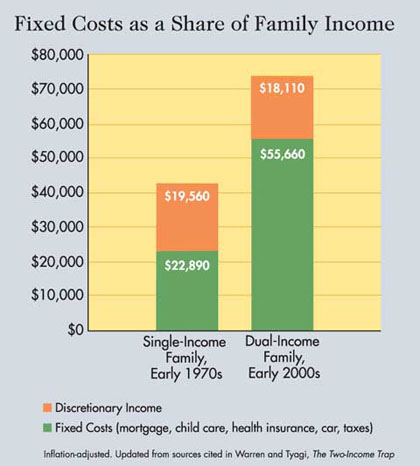
Where Does the Money Go in a Dual Income Family?


As I mentioned before, Harvard Magazine almost always has an unintentionally enlightening article, one that makes you say, "Well, yes, follow that thought through and you might get somewhere." Typically it concerns some issue where social science is demonstrating a deletrious effect of lifestyle changes which the magazine is compelled by its political stance to treat as beyond question.

So it is in this case.

In an article by Elizabeth Warren, the author talks of the "Middle Class on the Precipice," specifically referring to the dual-income family. Her argument is that the dual-income family model of economic life is far less secure than the former single-income family model that prevailed until 1970 or so.

Scholars, policymakers, and critics of all stripes have debated the social implications of these changes, but few have looked at their economic impact. Today the median income for a fully employed male is $41,670 per year (all numbers are inflation-adjusted to 2004 dollars)—nearly $800 less than his counterpart of a generation ago. The only real increase in wages for a family has come from the second paycheck earned by a working mother. With both adults in the workforce full-time, the family’s combined income is $73,770—a whopping 75 percent higher than the median household income in the early 1970s.

One good point the article makes is a single-income family can respond to a loss of the breadwinner's income (for whatever reason: death, injury, laid-off, fired, etc.) by sending the other parent into the paid labor force. Dual-income families don't have that option. In other word, single-income families work with a kind of discipline of deliberately keeping half of its potential labor force in reserve "for a rainy day," so to speak.

She also points out the tilting of the balance in the credit market from the debtors to the creditors, aided by Congress:

Since the early 1980s, the credit industry has rewritten the rules of lending to families. Congress has turned the industry loose to charge whatever it can get and to bury tricks and traps throughout credit agreements. Credit-card contracts that were less than a page long in the early 1980s now number 30 or more pages of small-print legalese. In the details, credit-card companies lend money at one rate, but retain the right to change the interest rate whenever it suits them. They can even raise the rate after the money has been borrowed—a practice once considered too shady even for a back-alley loan shark. When they think they have been cheated, customers can be forced into arbitration in locations thousands of miles from home. Some companies claim that they can repossess anything a customer buys with a credit card.

Smart people will avoid credit-card debt like dead birds in Turkey, but lots of people aren't smart, and the Bible tells us that God hates, yes HATES those who take advantage of their naivete. Even though they failed, we should be thankful for men like retired congressman Henry Hyde who tried to speak up for the debtors in the new bankruptcy law (and I know about the fraudulent use of bankruptcy; I know of a local millionaire of notoriously lax business ethics who regularly uses it to get out of inconvenient debts. Throw the book at him and people like him, but don't wink at the credit companies' loan sharking practices.)

Professor Warren also makes a good point about retirement risk being shifted on to the backs of families:

During the same period, families have been asked to absorb much more risk in their retirement income. In 1985, there were 112,200 defined-benefit pension plans with employers and employer groups around the country; today their number has shrunk to 29,700 such plans, and those are melting away fast. Steelworkers, airline employees, and now those in the auto industry are joining millions of families who must worry about interest rates, stock market volatility, and the harsh reality that they may outlive their retirement money. For much of the past year, President Bush campaigned to move Social Security to a savings-account model, with retirees trading much or all of their guaranteed payments for payments contingent on investment returns.

Now with these issues of retirement we have to remember that a defined benefit plan isn't a human right or a gift from heaven. Like many of the institutions that buttressed the security of the single-income families in the 1950s and 1960s they were created by unions, reformers (mostly women), and Democratic administrations who were animated by the ideal of the secure, home-centered, single-income family. (You can read more about this lost legacy of pro-family activism here.) Sadly their efforts were not accompanied by a similar focus on creating a pro-family culture, and so the result of the security and stability of the fifties was to create a generation that took it all for granted (Jeshurun grew fat and kicked . . .)

But unfortunately a good part of her article also aims to make the case that the dual-income model is irreversible (of course!), and driven by "rising prices for essentials as men’s wages remained flat." Actually though, the statistics she presents tell quite a different story. The only essential item that people are spending more on (and boy, are they spending more on it!) is housing. The only other major increases in the average budget are taxes, child care, and cars.

First she argues that families today are not living more luxuriously than in 1970; they are actually spending less on clothing, food, and household applicances:

. . . the average family of four today spends 33 percent less on clothing than a similar family did in the early 1970s. Overseas manufacturing and discount shopping mean that today’s family is spending almost $1,200 a year less than their parents spent to dress themselves. . . . Today’s family of four actually spends 23 percent less on food (at-home and restaurant eating combined) than its counterpart of a generation ago. The slimmed-down profit margins in discount supermarkets have combined with new efficiencies in farming to cut more costs for the American family. Appliances tell the same picture. . . . manufacturing costs are down, and durability is up. Today’s families are spending 51 percent less on major appliances than their predecessors a generation ago.

Even when we factor in the "23 percent more—a whopping extra $180 annually" spend on entertainment and the $300 more spent on computers, the total spent on all the above mentioned items combined is less for today's dual-income family that it is for 1970's single income family.

It's worth interjecting here that the savings in food and clothing are something which we can attribute to the Wal-Marts and Sam's Clubs of the world. Greater efficiency in the retail market has made a real difference to peoples' incomes.

So why are families today spending so much more? In a word, bigger houses and higher taxes, although the author struggles mightily to obscure the fact:

The data can be summarized in a financial snapshot of two families, a typical one-earner family from the early 1970s compared with a typical two-earner family from the early 2000s. With an income of $42,450, the average family from the early 1970s covered their basic mortgage expenses of $5,820, health-insurance costs of $1,130 and car payments, maintenance, gas, and repairs of $5,640. Taxes claimed about 24 percent of their income, leaving them with $19,560 in discretionary funds. That means they had about $1,500 a month to cover food, clothing, utilities, and anything else they might need—just about half of their income.

By 2004, the family budget looks very different. As noted earlier, although a man is making nearly $800 less than his counterpart a generation ago, his wife’s paycheck brings the family to a combined income that is $73,770—a 75 percent increase. But higher expenses have more than eroded that apparent financial advantage. Their annual mortgage payments are more than $10,500. If they have a child in elementary school who goes to daycare after school and in the summers, the family will spend $5,660. If their second child is a pre-schooler, the cost is even higher—$6,920 a year. With both people in the workforce, the family spends more than $8,000 a year on its two vehicles. Health insurance costs the family $1,970, and taxes now take 30 percent of its money. The bottom line: today’s median-earning, median-spending middle-class family sends two people into the workforce, but at the end of the day they have about $1,500 less for discretionary spending than their one-income counterparts of a generation ago.

Let's put this in tabular form in order of decreasing magnitude:

Mortgage then: $5,820; now: over $10,500 > + over $4,680
Taxes then: $10,188 (24% of income); now: $22,131 (30%) > +11,943 [since we generally agree taxes should be proportional to income this is misleading; had the tax rate stayed 24% per average family, today's tax bill would have been $4,426 lower].
Health insurance then: $1,130; now: $1,970 > +840

Even I was rather astounded by how really insignificant health insurances increases are compared to tax increases.

The other increasing expenditures -- for child care and for a second car -- are (at least in part) entailed by the decision to be a dual-income family:

Child care expenses then: $170*; child care expenses now: $5,660 (school age) -$6,920 (pre-school) > +$5,490 to $6,750
Car expenses then: $5,640 (for one car); now: over $8,000 (for two) > + over $2,360 [note the apparent implication that in real terms cars have gotten cheaper]

So while Professor Warren concludes that the dual-income family is a victim of forces beyond its control, and will eventually demand political action to reduce risk, what I conclude is that:

1) As long as you are willing to live in a small house and own one car, the single-income family makes as much sense as it ever did.

2) The desire for bigger houses is the main driving force behind the dual-income family.

And I can't avoid another query: is the flood of relatively unskilled female workers into the labor market keeping wages soft?

Tim Bayly has put up a very interesting post on big houses here. He questions why families with fewer children need more space. And if they don't need it, is it not squandering to buy it? What he doesn't mention is Isaiah 5:8-9:

Woe unto them that join house to house, that lay field to field, till there be no place, that they may be placed alone in the midst of the earth! In mine ears said the LORD of hosts, Of a truth many houses shall be desolate, even great and fair, without inhabitant.

Why woe to them? Because they have done injustice to seize other men's fields? Certainly. But is there not something antisocial in the very desire to "be placed alone in the midst of the earth"? And does not the desire for bigger houses drive the desire to move to the outskirts of town, which makes a second car necessary, thus creating the other big drain on the family income?

My conclusion is hopeful, though: economize on your house, and don't buy a second car, and a single-income family has a realistic chance of achieving the financial security and stability that so many dual-income families seek in vain. The government may not be helping, but most of our financial future is in our own hands, and following the traditional rules of life are the key to that future. (Gee, sounds like Proverbs!)

* Derived by subtracting all the other figures

Labels: ,

|

Saturday, October 15, 2005

Feminism vs. Egalitarianism

The very mis-named Augsburg [as in the Confession] Fortress [as in A Mighty] Press has a great new book out: The Jezebel Letters, in which King Ahab's Tyrian wife is portrayed first person, sympathetically as

a powerful, literate royal woman. . . .

a regal, wise, politically active wife, mother and queen in Israel . . .

the urbane and thoughtful Queen of Israel who gives voice to her efforts and those of her family in guiding Israel through one of its most challenging, and least understood, periods.

Russel Moore says the obvious about this here.

But what's a little less obvious is the dissonance between this feminist revisionism and the older liberation-theological agenda. Those familiar with the work of liberation Biblical scholars such as Norman Gottwald, who dedicated his classic Tribes of Yahweh to the Vietnamese people, or with the more moderate evangelical reflections of the same trend, such as Christopher Wright (his dissertation book here and a more popular exposition here), will know that Ahab and Jezebel are the Ronald and Nancy Reagan, the Donald and Ivana Trump, the Ferdinand and Imelda Marcos, the Louis XVI and Marie Antoinette of ancient Israel's proto-capitalist dynasty of greed.

The whole liberation-theological reading of the Old Testament works with the following story line: Israel was designed by God in the Mosaic law to be a land-locked, agrarian, anti-commercial, community of egalitarian clans (mishpaha), each provided hereditarily with a plot of land guarded by redemption laws and cancellation of debts from the kind of primitive accumulation of land that could have created a new class of the wealthy. Economic egalitarianism was to underpin the rejection of idolatry, and the sole kingship of YHWH.

But, with the rise of kingship, the expansion of the royal household and its officials sparked the creation of a class of new rich. The old redemption and debt-cancellation laws were rendered an empty letter as landlords joined fields to fields. Trade expanded as Israel's big-scale commercial farmers became suppliers of grain, oil, and other goods to Phoenicia's sea faring emporia, such as Tyre and Sidon. Meanwhile, the dispossessed small farmers fell in destitution, selling off their children to slave traders in Tyre for resale in Greece and Anatolia.

This development reached its peak in the luxury of Samaria, the new capital of Israel's Omrid dynasty of the 800s BC: Omri, his son Ahab, and Ahaziah their son. The full integration of Israel into the Near Eastern economy of large-scale plantation agriculture and slaves being sold for luxury goods in ivory, and precious metals was consummated when the Omrids tied themselves to Tyre by marrying Jezebel, daughter of the Tyrian king, to Ahab. Spiritually, the introduction of the idolatrous Tyrian cult of Baal into Israel with the attendant sexual immorality, drunkenness, and profligacy, was only the superstructural reflection of this infrastructural reduction of the common Israelite from a owner-proprietor into a mere means of producing surplus value for increasingly wealthy landlord class.

Now there is much to be said for this reading of the course of ancient Israelite history. While one might dispute the Marxist-style primacy of economics over theology, there is no question that the prophetic denunciations assume that idolatry and decline in personal ethics are advancing hand in hand with overall wealth, polarization of rich and poor, concentration of land holding, commercialization, and royal prerogatives. Now, even in the Mosaic model Israel was by no means as egalitarian as Gottwald would have us believe (I have posted something on this here). And there is also the tradition of kingship as positive, seen most clearly in the Psalms and the Davidic messianic theme. Even the empires of the Middle East can be viewed as generally benevolent patrons of the true Yahwistic state (see here). But overall, particularly in the divided monarchy, idolatry and personal immorality are viewed as part of one package with the disintegration of the old agrarian ideal.

So it is fascinating to see the feminists taking as a model this Jezebel, about whom the liberation scholars could agree with the evangelical and fundamentalist writers in seeing as the exemplar of everything wrong in Israel.

But this isn't anything surprising, I think. Contrary to popular belief, the prophets appear to be right, and modern thought wrong: social tolerance is generally linked to extremes of wealth and poverty. Small-scale egalitarian societies detest deviance of any sort, but in big cities where beggars crowd on the street corners, all forms of sexual and social non-conformism go unnoticed, and even applauded.

The 1950s is remembered as a drab, "family values," conformist era, unlike the exciting revolutionary 1960s, but it was one in which every indicator showed positive trends for the poorest in society. These trends towards diminishing the gap of rich and poor actually began to reverse in the supposedly more "egalitarian" 1960s. In the US today, the four states with the most equal distribution of wealth are Wyoming, Utah, New Hampshire, and Indiana: and all of them have a reputation as stodgy, Republican, conservative places, that artists, feminists, and other creative types flee on their way to New York or Los Angeles, where inequality is through the roof. Alexis de Tocqueville pointed out long ago, of course, that art and egalitarianism don't mix: that a powerful class of confident holders of wealth, whether aristocratic or bourgeois, is essential to nourish free thinking and combat the narrow-minded conformism endemic to societies all on one level.

So when the feminists laud Jezebel, they are in fact responding to deep cues in the Biblical text. They sense indeed that Ahab and Jezebel's Samaria, despite the destitute farmers offering their children for sale at the markets, would be a more comfortable environment for them than the egalitarian but fiercely Yahwistic shepherds of Tekoa. By the same token, however, this points out how unnatural the alliance of the newer cultural libertarian lobbies (gay rights, feminism, abortion, shock art, etc.) is with the old social democratic constituency (the unions, advocates of income equality).

Labels: ,

|