Monday, July 28, 2008

Eating Involves Killing -- No Matter What

In discussing a recent press statement by PETA about fur Wesley Smith here brought up the rarely discussed deaths of animals during harvesting. As he points out:

Plant agriculture results each year in the mass slaughter of countless animals, including rabbits, gophers, mice, birds, snakes, and other field creatures. These animals are killed during harvesting, and in the various mechanized farming processes that produce wheat, corn, rice, soybeans, and other staples of vegan diets. And that doesn’t include the countless rats and mice poisoned in grain elevators, or the animals that die from loss of habitat cleared for agricultural use. . . . Field animals may flee in panic as the great rumbling harvest combines approach, only to be shredded to bits within their merciless blades; they may be burned to death when field leavings are burned; they may be poisoned by pesticides; they may die from predation when their plant cover has been removed.

One might think this is just some conservative tu quoque argument, or else an artifact of awful, inhuman, industrialized factory farming. But actually the idea of grain agriculture as an animal holocaust is a fixed part of Buddhist belief, at least. In a recent study of Tibetan nomads, who lived off of slaughtering animals, the author Rinzin Thargyal notes:

Most of [his nomad informants] thought that farmers were bigger sinners than themselves as nomads, because the farmers killed countless worms and other living beings in the process of ploughing and sowing their fields. Nomads did not take too many lives and the preference for killing bovines was that one single animal could provide enough meat for many people over a longer period, thus involving much less total life-taking overall (p. 182).

And don't think the slaughtering the nomads did was all that humane:

Suffocating the animal was the standard form of killing. The animal was first hobbled and then felled down on the ground, then a rope was tied around the mouth very tightly. The whole process took about half an hour, after which the eyes of the animal became bluish, indicating a lack of oxygen (p. 87).

And the offspring of ox-yak crossbreeds were starved to death:

All tole or zomo calves were starved when very young [i.e. the people took all the milk and let the calves starve]. My informants hesitated to impart this piece of information to me initially, but they gradually admitted that they sometimes had to resort to what was a sinful act in Buddhist terms in order to survive as they did. Since only a few households kept zomo, most of them could avoid committing this form of killing (p. 83).

Even so, the killings involved in agriculture play a major role in the Buddhist view of the world. Here is a great analysis (from this book) based on field-work in Ladakh:

. . . Monks were discouraged from agricultural labor, and particularly the production of staple crops such as barley and peas. Both monks and laity agreed that such work was digpa (a term often glossed as 'sinful,' but more accurately implying an action which causes negative karma), since it killed many insects and worms, as did any digging or plowing. Normatively, involvement in agricultural activity was expected to decrease as a monk entered more senior ranks . . . Most agreed that it would be out of the question for the head monk to involve himself in any act of agricultural production, with some laity feeling that he should not even enter the fields of the village during the later summer months (p. 70).

Of course the other side of monastic renunciation is social reproduction (i.e. marriage and heterosexual relations). As Mills shows, plowing and sex are both seen as creating wealth (plowing by creating seeds, and sex by creating laborers for the farm). The householder is the wealth creator, producing both the grain to feed the monks, but also the future monks themselves. The practice of farming and sex are necessary to the survival of the monastic community, but the two are separated strictly by rules that separate the two in separate but complementary roles.

Not to speak of the viewpoint of the Manicheans whose founder Mani had a vision of plants suffering from the knife . . .

Like all world-changers, vegetarians are convinced that with a few simple adjustments, a life without inflicting harm on anyone are within our grasp. I have my doubts. Maybe it is because I sometimes feel uneasy swatting mosquitoes or crushing ants in my house. (And then I do it anyway and feel uncomfortable.) And when I have planted a plant, I have a deep-seated reluctance to kill it; especially if it seems to have a strong desire to live, despite frequent blows.

Maybe I'm just nuts, but I also have a feeling that the permission granted men and animals to eat plants worldwide in Genesis 1:29-30, and for Adam to eat Eden's plants in 2:16, and the extension to animals (including creeping things like worms and insects) of Gen. 9:2-3 was not just pro forma, that without God's specific permission it really would be wrong to eat plants. After all He made them and they are also our fellow creation. Do they actually belong to us?

(It's also worth noting that Genesis 1:29-30 and 2:16 are not saying the same thing. One gives all the plants of all the world to all men and animals. The other gives the plants of Eden to Adam alone. If you don't just assume, well, eating plants is always OK anywhere anyway, then that's a pretty big difference. Only by Genesis 3:23 does Adam come into a relation with the plants outside Eden; in Gen. 2:15 he only cared for the plants in Eden. Assuming that caring for is connected to eating, this places the universal permission to eat after the expulsion from Eden. This is grist for my mill that the blessings of Genesis 1:28-30, and the description of the world as "very good" in v. 31 are properly read as describing the situation after the expulsion from Eden, not before.)

One final thought in an incoherent post: as people out to change the world, vegetarians share the key characteristic of moral reformers and activists of all causes: that with a few changes, we can all lead sinless lives -- if we really want to. I appreciate the simplicity and purity of the reformers' zeal, I really do. But somehow I just can't share it. Somehow to me the idea that we are stuck in a world in which we cannot help but sin -- ethical fatalism, the idea that we are not in charge of whether we are good people or not -- seems a lot truer. (Of course moral reformers might say that's because I'm complicit in all sorts of evil I don't want to end, because I benefit from it. Or maybe I'm just passive. I suppose that might be true too.)

Labels: , , , , ,

|

Friday, July 04, 2008

Thoughts on a Shrinking World, Mass Migration, and Changing Customs

Under the Mongol dynasty in China, the Yuan, unprecedented numbers of Westerners -- Uyghurs, Tibetans, Turkestanis, Persian, Arabs, Russians, Ossetians, Armenians, and even the odd Frank, like Marco Polo -- migrated to the country. Once they migrated there, receiving high position in the Mongol-run administration, many, if not most, stayed, and their sons and grandsons began adopting Chinese customs.

The attitude of Chinese to this differed. Leaving aside a small cranky minority in South China who still maintained loyalty to the defunct Song dynasty, most Chinese scholars were proud that people were coming from all over the world and converting to Chinese ways. But what about those who changed their surnames and customs to adopt those of China? Was that a good thing? Some thought that truly filial and Confucian Westerners would not change their family name and hence insult their ancestry as something to be gotten over. Others thought it was natural for people to change their name and customs when entering a new world.

Here is a sample of viewpoints on this phenomenon drawn from Chinese-language essays of the thirteenth and fourteenth centuries. The source is Chen Yuan's Western and Central Asian in China Under the Mongols, translated by Qian Xinghai/Ch'ien Hsing-hai and L. Carrington Goodrich. (I have modernized the spelling, but I haven't necessarily referred to the original Chinese to check, so I cannot vouch for the correctness of each phrase or terminology.)

Wang Li in his Linyuan ji, thought it showed how the Mongol Yuan dynasty has expanded the brotherhood of man.

The language and tastes of the people of the Western Regions differ from those of the Chinese. Although since the days of Han and Tang intermarriage has occurred, still each retained his own racial allegiance and could not live permanently in the other's domain. How could those born in the lands of the West be interred in Jiangnan [the lower Yangtze area]. Now under our imperial house of the Yuan, when the foundation of the empire was being laid, the people of the Western Regions rendered valuable service. By the time of the Renovating Founder [that is, Qubilai/Kubla Khan], the land with the Four Seas had become the territory of one family, civilization had spread everywhere, and no more barriers existed. For people in search of fame and wealth in north and south, a journey of a thousand li was like a trip next door, while a journey of ten thousand li constituted just a neighborly jaunt. Hence among Western people who served at court, or who studied in our south-land, many forgot the region of their birth, and took delight in living among our rivers and lakes. As they settled down in China for a long time, some became advanced in years, their families grew, and being far from home, they had no desire to be buried in their fatherland. Brotherhood among peoples has certainly reached a new plane (p. 252).

Liu Yin in his Jingxiu wenji thought the custom of changing one's surnames to fit Chinese models a sign of bad morals. The Guli family of the Jurchen (a people of Manchuria, ancestors of the later Manchus) had taken on the Wu surname, and Liu Yin comments:

When I heard this, I said that this was a great mistake. The family surname had been received by the clan's forefathers and handed down to posterity, and the lineage should not be confused in the slightest degree. . . . They have of their own volition cut off their own roots, and allied themselves with another family. This is indolence and drifting with the current (p. 236).

Other critics like Wu Hai in his Wengaozhai ji, blamed this on careerism. Officials would receive surnames from the government and would not refuse them, lest doing so impede their careers:

The idea was that the new family name, bestowed by the Son of Heaven, could not be refused; while the old name had been handed down by his ancestors and should not be discarded. [A friend of his had showed him his genealogy, where he had listed both family names, old and new, side by side]. Hence both were retained. The moral sense of the people at present is enfeebled. People are bent on acquiring official position and wealth. Some have willingly sacrificed their ancestral heritage and adopted that of this country in order thereby to gain promotion in their careers. Is there one who has accepted a surname bestowed on him and yet is reluctant to give up the old one? On glancing over this genealogical record I could not but feel regretful. One may hope that people who have given up their forefathers may take a look at this record, be moved by it, and change their course of action (p. 237).

Others, like Song Lian in his eulogy of Pu Bo, a Muslim whose family settled in S. China, argued that when situations change, culture should change too:

The people in countries of the Western Regions had no family names; they were known rather by the tribes to which they belonged. They were unsophisticated and their affairs simple; as a consequence, it was easy for them to get along in this way. As to Master Pu [Pu Bo, a man of the Muslim Arghun people of Inner Mongolia], his family lived for three generations in regions of China known for their culture [i.e. in the Lower Yangtze]. He equipped himself with understanding of the History and the Odes [books in the classical Chinese canon] and put into practice the principles of our rites and rules of propriety. His old name he kept, however, which is not as it should be. On consultation with fellow officials and scholars he adopted Pu as his surname. In former times when the people of rank of northern Dai [northern Shanxi, on the northern edge of China proper] followed the rulers of the Northern Wei [a early Mongolic dynasty of the fifth-sixth century AD] and pushed down into Henan, they all followed Chinese customs, changing their three and four syllable names to those of one syllable, and in other respects adopting Chinese ways. The step taken now by Mr. Pu coincides with ancient principles and current practice. Were he not a man of unusual insight, he would not have seen this. Those who abide by ordinary practice might say that their forefathers did not introduce the change. That is because they are unqualified to talk about accommodation [or changing to conform]
(p. 240).

Wu Chen praised Shadi, with the courtesy name Xingzhe, for the adoption of the Chinese system of given names (ming) and courtesy names (zi), the later bestowed by respected colleagues or teachers. He was a member of a sayyid (descendant of Muhammad) family from Central Asia which settled in Yuan China and achieved high position, :

In remote antiquity, people had given names, but no courtesy names -- a sign of their simplicity. In ancient times people had both given names and courtesy names -- a sign of their culture. Within the nine provinces [of China], civilization was emphasized, as it was in medieval times and thereafter. Outside the nine provinces simplicity was stressed, just as it had been in remote antiquity. This difference in practice has existed throughout the ages. The domain of the reigning [Mongol Yuan] dynasty is the most extensive one of all times. All countries, both those within and without the nine provinces are in this domain and form one household. Each having its own customs, it has not been possible to unify them . . . . [Wu Chen then describes how he was given a courtesy name by his fellow officials] What is commendable in this Chinese custom is that the rules of what is right and proper, as laid down by the Duke of Zhou and Confucius, are admirable. Whoever esteems the rules of the Duke of Zhou and Confucius should follow them. Those who think highly of them but fail to follow them are untrue to civilization; they esteem culture, but are false to it. This is not like the genuineness of esteeming simplicity . . . (p. 228).

For others, the answer was to adopt a surname that had some connection with one's ancestry, thus preserving both a justifiable loyalty to one's ancestry and a fitting appreciation of culture. The Xie family of Uyghurs, for example, chose a rare form of this name due to its use in the Chinese transcription of Selengge, the river in Mongolia where his ancestors had come from centuries earlier. Xie Chaowu's name was based on the Mongolian cha'ur "warrior." So Wang Deyuan wrote about him in a eulogy thus:

Xie Chaowu, courtesy name Angfu, was a Uyghur. His given name was Mongol and his courtesy name Chinese. Men spend their life in different regions. As he continued to use the name of his tribe and did not forget his ancestor, he was filial. As he served in a glorious period of the house of Yuan and continued to use his given name not forgetting his country, he was loyal. In studying the standard literature of the Chinese, he freed himself from the charge of illiteracy. In continuing to use his courtesy name he did not forget his teacher, which indicates his sensibility. Being dutiful, loyal, and wise, his moral foundation was laid (p. 143).

For some adaption was a difficult process in which they had to try to find some common moral principles between their ancestral principles and their adopted country's mores and ethics. Xu Youren records the ambivalence of Heshu, another Muslim migrant to China -- and also reminds us that many immigrants made no effort to adapt:

When our house of Yuan launched expeditions against the countries of the northwest, the Western Regions were the first to become part of our realm. Accordingly, many more natives of the West were accorded high positions than those of other lands. Great merchants monopolized advantages in operating profitable enterprises on land and sea. They occupy key places in well-known cities and regions throughout the empire, and enjoy their large incomes, but few are successful in adapting themselves. They live in this country, are clothed and fed here, but they still cling to the customs of their own countries. Heshu, however, declared: 'I do not dare to alter our customs, and thereby become estranged from my own people. I wish only to change what is contrary to moral principles. I have lived in this country, been clothed and fed here, and shared the life of its people. I take no pleasure in altering our ways in order to conform to the customs of this area. But when I reach a decision about them, I wish to conform to that which is right. One of my ancestors came to China as an ambassador and his bones lie buried here. Can I afford to ignore the Odes, History, Rites and Music? [These are books in the Chinese classical canon.] When customs are dissimilar due to differences in underlying principles, should I follow them?' Ah! Heshu was certainly good at adapting himself in the way Mencius proposed [a reference to where Mencius tells the story of people who reformed non-burial of the dead simply by natural feeling, without ever being taught to conduct burials]. According to their mores [that is, Muslim ones], they did not erect monuments at the tombs of their ancestors, but he did so (p. 243).

These are the cultural options still today, in a shrinking world of mass migrations. Perhaps the most distinctive element is the sense of attachment to a particular land, in which the migrants are "fed" and "clothed" by the land, and hence owe something to it.

Labels: , , , , ,

|

Friday, May 23, 2008

Actually Existing Complementarianism

Imagine someone who said to you: "I used to believe that premarital sex was just wrong. Then my daughter started dating and got pregnant. Since then our family has been completely overturned, and my Christian life devastated. As a result of all these troubles, I've realized all that stuff about premarital sex being against God's plan for families is just wrong." If you are like me, you'd think the logic was a bit strange. Isn't the trouble that follows from breaking the law you used to believe in normally seen as confirmation of the law's justice? I mean when violating some rule makes for unhappiness all around, we conclude that the rule might make sense. But if the person saying the opposite seems otherwise intelligent, we might assume that there is something else there, some hidden assumption going unexpressed, that makes the logic make sense. And if scores of other people agreed with the person when he said that, we might conclude that these hidden assumptions are actually widely shared. And that would be so even if those assumptions contradict the explicit theology of those persons.

I am thinking about the iMonk's recent post on his agony attendant upon his wife, Denise, becoming a Catholic (he's a Southern Baptist pastor). I would link to it, but it seems to have been removed by him from his site. I don't want to talk about the personalities and rights and wrongs of it all, but as I remember the post, it did have something of the shape: "I used to believe in a man's spiritual leadership in the home; my wife has rejected my spiritual leadership; my life and family are now in complete chaos; so I realize how wrong I was ever to believe in a man's spiritual leadership in the home." Now since this makes no sense at all logically and since the iMonk is certainly an intelligent person, it's clear that there are some hidden assumptions going unexpressed. And I am going to tell you what they are, and why they are there. And I'll start off by saying that those hidden assumptions are not his, but his quite accurate understanding of the sub-text of what "complementarianism"* means in churches that practice it.

Now, in theory "complementarianism" means something like this: "God has given to men a duty to exercise leadership (especially religious leadership) in the home and in the church." Corollaries include the idea that violation of this cause trouble, and so on. Let's call this "theoretical complementarianism."

But that is not all that "complementarianism" means, and not even the main part. It is certainly not the proposition that the iMonk saw completely shattered by his last year as his wife prepared to convert to Catholicism. Rather what was shattered is a quite different proposition: "When men exercise spiritual leadership in the home and church, women will inevitably welcome and follow this leadership." This would have the corollary that "If women deny male headship in church or home, it is all the fault of the men over them." You could also phrase it as "When men exercise spiritual leadership in the home and church, God hears their prayers and makes those who should follow, do so." Practically the result is the same: where men lead rightly women do, in fact and practice, follow. Let's call this proposition "actually existing complementarianism."

Now this would certainly be shattered by the iMonk's experience. He thought he was a good husband and good Baptist pastor -- and now his wife is rejecting his spiritual headship by becoming Catholic. So he now has two alternatives: 1) continue to accept actually existing "complementarianism" (as opposed to the theoretical version in the paragraph above) and take the blame as the bad husband and bad pastor whose failures drove his wife into Catholicism, and prevented God from responding to his desperate prayers; or 2) reject actually existing complementarianism. Now if theoretical complementarianism has been firmly enough linked to actually existing complementarianism, then rejecting the second will mean rejecting the first.

Now, what is the relationship between these two propositions? It certainly isn't some kind of logical corollary. Let's take an analogy: "God had ordained civil authorities as enforcers of the law and all citizens should obey" and "If civil authorities properly enforce the law, all citizens will obey" are independent propositions. None thinks the second follows from the first as some kind of automatic corollary. Likewise, the idea that good parents, for example, never get grief from teenage kids is not part of usual Christian teaching. So how did the Southern Baptist Church, and other churches teaching the same, get from one to the other in the case of husbands and wives?

Even stranger is that "actually existing complementarianism," despite being taught in Christian churches, seems to contradict Christian teachings about human nature. For example, original sin. How can we believe that an original sinner pastor/husband could ever exercise leadership well enough that "actually existing complementarianism" could be anything other than a purely theoretical issue? And how can we believe that even if the pastor/husband is perfect, an original sinner wife/congregant would inevitably welcome this leadership? I mean, does the Bible really teach that when prophets and priests lead in God's way that people always and inevitably follow? In fact, "actually existing complementarianism" is simply an assertion that both men and women can and will fulfill the law of theoretical complementarianism.

Actually existing complementarianism looks very much like Mencius; you know, the Confucian philosopher who argued that human nature is inherently good. Mencius was asked how a prince should get the common people to observe proper ritual. The answer? Just lead and the people will inevitably follow:

The prince said again to Ran Yu, 'Hitherto, I have not given myself to the pursuit of learning, but have found my pleasure in horsemanship and sword-exercise, and now I don't come up to the wishes of my aged relatives and the officers. I am afraid I may not be able to discharge my duty in the great business that I have entered on; do you again consult Mencius for me.'

On this, Ran Yu went again to Zou, and consulted Mencius. Mencius said, 'It is so, but he may not seek a remedy in others, but only in himself. Confucius said, "When a prince dies, his successor entrusts the administration to the prime minister. He sips the congee. His face is of a deep black. He approaches the place of mourning, and weeps. Of all the officers and inferior ministers there is not one who will presume not to join in the lamentation, he setting them this example. What the superior loves, his inferiors will be found to love exceedingly. The relation between superiors and inferiors is like that between the wind and grass. The grass must bend when the wind blows upon it." The business depends on the prince.'

Ran Yu returned with this answer to his commission, and the prince said, 'It is so. The matter does indeed depend on me.'

So for five months he dwelt in the shed, without issuing an order or a caution. All the officers and his relatives said, 'He may be said to understand the ceremonies.' When the time of interment arrived, they came from all quarters of the State to witness it. Those who had come from other States to condole with him, were greatly pleased with the deep dejection of his countenance and the mournfulness of his wailing and weeping.

Now Mencius believed firmly in the goodness of human nature and the naturalness of Confucian ethics. And there is something in this that responds to our usual moral intuitions. If the government is good, people will obey -- generally and as a rule. But conservative Presbyterians and Baptists believe just as firmly in original sin and the unattainability of the Christian ethic. So how did this teaching of actually existing complementarianism get established?

Certainly it is not particularly traditional. I have read quite widely in the pre-20th century Christian tradition, and while theoretical complementarianism is virtually universal in it, the actually existing kind seems nowhere to be found. In other words, a model of family life is set out, but there is no real expectation that just because the husband follows it the wife will -- or the other way around. In general if you act well, the other person in the marriage will frequently respond, but there's nothing inevitable about and nothing shocking when he or she doesn't reciprocate. So why is it so important to insist in conservative Christian churches that traditional sex roles is entirely up to the pastor/husband, and that he alone, simply by personal rectification, can inevitably make them welcomed in his household?

Several reasons, I think. One important one is because of the dynamics of the church teaching situation. Most teaching that takes place in Christian churches in a market environment is men teaching women. When a male pastor teaches actually existing complementarianism, he is doing several things: 1) assuring the women in his audience that they will not be, and cannot be, compelled to submit to their husband's leadership; it's purely voluntary. 2) He is building up his own sense of righteousness and manliness. Look at it this way: actually existing complementarianism has as its corollary that any man to whom women submit is exercising leadership properly (OK, it's not exactly a strict logical inference, but it's close enough for real life.) If I as a Southern Baptist pastor tell my mostly female congregation that they should submit to male headship in the family and church -- but only when the man's leadership is godly --, and they prefer my preaching to that of the Methodist church with a woman pastor down the road or to their own good-for-nothing husbands, well then, then my leadership must be godly than theirs. And godly in a specifically male way.

To a certain degree, then, "actually existing complementarianism" is a way of throwing down the gauntlet to other men: if you are a real man, your wife will welcome your leadership, and if she doesn't -- well then, you mustn't be a real man. Now if the iMonk was raised in this kind of environment it's easy to see why his wife becoming Catholic was a shattering humiliation. He could either live with the humiliation or rip up the whole game. No wonder he chose the second.

But this sort of real man one-ups-manship has been going on for a long time, and actually existing complementarianism is a new thing. So there must be something new in the situation to account for it. Here's the new thing: complementarianism has become an "ethnic" marker, a marker that separates the people of God from outsiders. And it is the distinctive feature of such marker-laws that they have to be attainable. Think of it this way, if not eating pork is the mark of a Jew as one of the people of God, then not eating pork has to be a fulfillable command. If somehow it's not possible to not pork, then all kinds of people who want to be Jews will be turned from Jews to gentiles against their will. And if your life is built around your religious community, that's pretty upsetting.

But the use of marital relations as a marker of being part of the people of God is actually pretty new. In 1858, liberal Episcopalians and evangelical Baptists all had pretty much the same view of family ethics. In 1958, differences were there, but with at a fairly high level of abstraction. But today, views on "complementarianism" vs. "egalitarianism" have becoming major denominational distinctives. If "complementarianism" defines the Southern Baptists, then "complementarianism," (like teetotalling, but unlike loving your neighbor, which all denominations try to do and all fail at perfecting) has to be do-able. Otherwise you won't have any credible "witness." If you are a member of, to chose a different example, a conservative PCA church, and want to remain so, having a good "complementarian" marriage, is as important as not eating pork as is to remaining an Orthodox Jew in good standing. (OK, I exaggerate a bit -- but only a bit.)

Now I can't think of anything less well-suited to be a dividing line between the clean and the unclean than marital relations. An insider/outsider marker should be: 1) easily documented, one way or the other; 2) clear-cut at any point whether you are living up to it or not; 3) Not connected to personality. Otherwise you are saying only one personality type is allowed in this denomination, which is going to drive vast numbers of growing children out of your body each generation; 4) individually determined, so that whether you adhere or not is under your own control, not someone else's. Now, you might point out that kosher rules are set by the family; if a wife refuses to keep a kosher kitchen, the Orthodox Jewish husband's stuck. But in this case, Jewish law allows and would even encourage divorce of a spouse who refuses to comply with membership codes. But in Christian churches, divorce is not explicitly recognized as an option (although in reality it plays an important under the table role in border-maintenance). But what you have in "complementarian" churches is a marker of cleanliness that is hard to check, dependent on endless subtle shades of interaction, determined by the interaction of two distinctive individual personalities, and in the end, out of the control of either partner. This can't help but cause anxiety.

(It is also true that explicitly liberal churches who place emphasis on being progressive have the mirror image problem, giving you the widespread figure of the bossy husband and mousy wife in a UU or Episcopalian church desperately denying that their family order is traditional patriarchy. But since liberal churches are in step with the wider society, are in fact the wider society at prayer, ideological consistency lacks the peculiar imperatives of border maintenance. If you admitted you act like a patriarch, despite believing in "a woman's right to chose", you'd just be a jerk, and not a social outcast.)

In this situation you need desperately to avoid the suggestion that justification by this particular Law is out of your hands. You have to believe that "complementarian" marriages are clearly and easily distinguished from "egalitarian" ones. That conscious belief and will, not the myriad shades of in-born personality types built by each person's unique nature and nurture, determines your interaction with your spouse. That husbands as leaders and wives as followers can indeed be close to sinless enough for actually existing complementarianism to apply.

To admit that these beliefs are obviously false, and would sound as strange and contrived in 1858 as they do today, is hard to bear. (Think of it this way -- have you ever read any good literature built on these principles? I thought not. And if it can't make a good novel, it probably can't be lived out in real life.)

But anything else leads to the dreaded condition of ethical fatalism, the believe that whether or not you are a good person and a member in good standing in the church is out of your hands. And that dreaded condition was what giving your life over to Christ was supposed to get you out of.

So my conclusion is, that "actually existing complementarianism" is created not by traditional Christian doctrine ("theoretical complementarianism") itself, but by that doctrine in interaction with a particular sociological situation: gathered congregations in a religious market in a society with serious conflict over marital ideals . Since those sociological features aren't going away, so too actually existing complementarianism isn't going to go away any time soon. But as you could probably tell, I believe it is overall pretty destructive. That is, however, not because traditional Christian teaching on the family is wrong, but rather because this good Law is being misused. I tend to agree with the biologists that people are mammals, and that means that when males are actually in the pack they generally lead it, and that females have a natural connection with child-raising*. People are overall happier and children are overall better raised where our heritage as a particular sort of mammalian creatures is worked with and not fought against. But daily interaction between husband and wife is just not something that can be legislated. If churches want border-markers between "complementarianism" and "egalitarianism" let them use nice and simple devices that are suited for the purpose, such as wives taking their husband's family name, or including "obey" in wedding vows -- do it once, in public, and then you can forget about it and get on with trying to be a good husband and father, wife and mother, without letting -isms get in the way. That's the approach of conservative liturgical churches and while it is less effective at challenging the broader society, it breeds fewer shattered and bitter opponents like the iMonk.

UPDATE: Here it is in black and white, as another comment of Michael Spencer's troubles.

*I must say, the sheer ugliness of this word is something of a tip-off to the absurdity of some of the views associated with it. It reminds me of what Disraeli once said of "conservatism" back when that new word replaced good old "Tory": "It sounds like something made by a pastry chef."
**Spotted hyenas, where females lead the pack, also have pseudo-male genitalia and aggressive temperaments due to an embyonic bath of testosterone. They are the mammalian exception that proves the rule (more here).

Labels: , , , , , , ,

|

Tuesday, April 01, 2008

Ever Wonder What Happened to Naaman after He Went back to Damascus?

Well, if you haven't, I have. There is that passage in 2 Kings 5:

And Naaman said, "Shall there not then, I pray thee, be given to thy servant two mules' burden of earth? For thy servant will henceforth offer neither burnt offering nor sacrifice unto other gods, but unto the LORD. In this thing the LORD pardon thy servant, that when my master goeth into the house of Rimmon to worship there, and he leaneth on my hand, and I bow myself in the house of Rimmon: when I bow down myself in the house of Rimmon, the LORD pardon thy servant in this thing." And [Elisha] said unto him, "Go in peace." So he departed from him a little way.

Needless to say, a strong current of interpretation says that we need to be angry at Naaman for "compromising with idolatry" and wonder that Elisha permitted it.

I'd rather read this along with the story of King Hakon the Good. He had come from England, where he had been baptized in A.D. 934. Going up to Trondheim, the richest district in the kingdom and the chief place of sacrifice in pagan Norway, he made an address,

to freeholders and husbandmen alike, of high and low estate, and so to all the people, young men and old, rich and poor, women as well as men, that all should let themselves be baptized and believe in one God, Christ, the son of Mary, and stop all idolatry and heathen worship; that they should keep holy every seventh day, abstaining from work, and fast every seventh day. (Heimskringla, p. 108).

The farmers grumbled against this because a Sunday rest would cut their income, and the working men and thralls thought they couldn't work on Friday without food. A farmer then gave a long speech (as cited by Snorri Sturluson), that emphasized how they wished Hakon to rule according to the inherited usages of the kingdom and not force them to abandon the customs they had from their fathers:

"But now we don't know what to think, whether we have regained our liberty or whether you are going to make us thralls again with the strange proposal that we should abandon the faith our fathers had before us, and all our forefathers, first in the time when the dead were burned, and now in the age when the dead are buried. And they were better men than we, and yet this faith has served us very well. . . . We all want to follow you and to have you be our king so long as one of us farmers who are at the assembly now is alive, if you, sir king, will observe moderation and ask only that of us which we can give you and which is within reason.

"But if you mean to pursue this so high-handedly as to contend against us with force and compulsion, then all of us farmers have made up our minds to desert you and chose another leader, one who will help us freely to have the faith we wish to have" (Heimskringla, p. 109).

The farmers all cheered this.

Earl Sigurd of Trondheim then negotiates between the two sides to delay a decision. But it couldn't be avoided.

In fall, at the beginning of winter there was a sacrificial feast at Hlathir [the temple seat on the other side of the Nidharos river in Trondheim], and the king attended it. Before that, if present at a place where heathen sacrifice was made, he was accustomed to eat in a little house apart, in the company of a few men. But the farmers remarked about it that he did not occupy the high seat when there was the best cheer among the people. The earl told him that he should not do that; and so it came that the king occupied the high seat on this occasion.

But when the first beaker was served, Earl Sigurd proposed a toast, dedicating the horn to Odin [chief of the Norse gods], and drank to the king. The king took the horn from him and made the sign of the cross over it.

Then Kar of Gryting said, "Why does the king do that? Doesn't he want to drink of the sacrificial beaker?"

Earl Sigurd made answer, "The king does as all do who believe in their own might and strength, and dedicated this beaker to Thor. He made the sign of the hammer over it before drinking." People said no more about it that evening. Next day when people had seated themselves at the tables, the farmers thronged about the king, saying that now he must eat the horse meat [the horse was sacrificed to Odin]. That, the king would not do under any condition. Then they asked him to drink the broth from it. He refused to do that. Then they asked him to eat the dripping from it. He would not do that, either, and they came near to making an attack on him. Earl Sigurd said he would help them come to an agreement, asking them to cease their tumult; and he asked the king to gape with his mouth over the handle of the kettle on which the smoke of the broth from the horse meat had settled, so that the handle was greasy from it. Then the king went up to it and put a linen cloth over the handle and gaped with his mouth over it. Then he went back to his high-seat, and neither party was satisfied with that (Heimskringla, pp. 110-11).

Later, the men of Trondheim even got together and sailed south to other parts of Norway and burned three churches and killed three priests.

But when King Hakon and Earl Sigurd came to Maerin with their troops, the farmers were there in very great numbers. The first day at the banquet the farmers thronged in upon him and asked him to sacrifice, or else they would force him to. Then Earl Sigurd mediated between them, and in the end King Hakon ate a few bits of horse liver.

Earl Sigurd tried to calm the king, but in the end, he left Trondheim swearing vengeance:

The king was so enraged that no one durst speak to him (Heimskringla, p. 112).

The conflict is cut short by an invasion of rivals for the throne, sons of his half-brother Eirik. He drives them out, but they harry Norway for the rest of his reign. In year 961, they invade again, and King Hakon is wounded.

King Hakon boarded his warships and had his wound bandaged. But the blood flowed so profusely that it could not be staunched. And as the day wore on the king became faint. . . . .Then he called his friends to his side and told them his wishes about the disposition of the kingdom. His only child was a daughter, Thora by name. He had no son. He requested them to send word to the sons of Eirik that they were to be kings over the land, but that they should exercise forbearance to his friends and kinsmen. "But even if I be granted to live," he said, "I would leave the country to abide among Christians and do penance for what I have sinned against God. But if I die here, among heathens, then give me such burial place as seems most fitting to you."

And a short while afterwards, King Hakon died on the same slab of rock where he was born. King Hakon was mourned so greatly that both friends and enemies bewailed his death and declared that a king as good as he would not be seen again in Norway. His friends moved his body north to Saeheim in North Horthaland. There they raised a great mound and in it buried the king in full armor and in his finest array, but with no other valuables. Words were spoken over his grave according to the custom of heathen men, and they put him on the way to Valhalla
(Heimskringla, pp. 124-25).

Observations:

King Hakon attempted to winsomely represent the Christian faith in a position of leadership and was a greatly admired king -- and was for his pains even denied a Christian burial by the men who loved him.

It's not enough to let the men of Trondheim have their religion while you have yours. If you rule them, you have to eat the horse liver -- or at least gape your mouth over the greasy handle.

Eventually, Olaf Tryggvason did Christianize Norway. In the Heimskringla, his chapter entries read like this: "The King Has the Warlocks Burned"; "The King Forces the Farmers to Accept Christianity"; "King Olaf Destroys the Idols"; "Eyvind Kinnrifa [a die-hard pagan] Is Tortured to Death by King Olaf"; and so on. Of King Olaf it was said:

King Olaf was of a most cheerful disposition and full of fun. He was friendly and affable, impetuous in all matters, exceedingly generous, and a fine dresser. He exceeded everyone in bravery when in battle. When angered he was very cruel, inflicting tortures on his enemies. Some of them he had burned with fire, some he let wild dogs tear to pieces, others he had maimed or cast down from high cliffs. For these reasons he was beloved by his friends and feared by his enemies. And he had such success, because some out of friendship and good will did what he wanted done, and some, because of fear of him (Heimskringla, p. 218).

So which of the two gained the world and lost his soul? Or both? Or neither?

Labels: , , ,

|

Saturday, September 23, 2006

Buddhists and Christians Together (for Dinner at Least)


A Buddhologist colleague once mentioned that she'd heard a colleague point out (yes, this is third hand) that you could see the Protestant origin of Religious Studies in its focus on doctrines as the center of religion. But if Religious Studies had started in Judaism or Hinduism, on the other hand, the person said, you'd see that food practices are really the center of religion.

I was reminded of that in my summer trip to Russia. In an interview with the Khambo Lama or abbot of the newly revived Aga datsang (monastery) -- that's a picture there -- he told me a funny story about the recent Congress of World Religions in Moscow this summer (details here and here). The Jews could only eat kosher, and the Muslims could only eat halal. So the result was only the Christians and the Buddhists could eat together! (He didn't mention the Hindus, but they have their own purity regulations and rules -- no beef, certainly.)

Actually Buddhism and Christianity have this similarity: they are both explicitly multi-ethnic religions, whose early writings expressly attack the purity legislation, food laws, and ethnic exclusiveness of their ethnic parent religion -- Hinduism and Judaism respectively.

In fact, one could argue that Christianity and Buddhism are the only well-established really multi-ethnic religions in the world. Virtually all the other religions of the world are for one ethnic group alone.

And what about Islam? That's a fascinating case. I think you could argue that while Islam accepts adherents from every ethnic group, it follows the American ideal of a melting pot: e pluribus unum ("from many, one"). I've touched on this before (see here). Traditionally, this was a purely eschatalogical ambition, but this aim of absolute cultural unity of the Islamic world is getting a lot more traction lately (see here).

Not eating together can strike people as very offensive. Qubilai Khan (a.k.a. Kubla, Kublai) in 1280 invited some Muslim merchants to his palace but they demurred and would not eat his meat, because it was slaughtered in the Mongol fashion. In a rage at what he saw as their arrogant refusal to accept that he was their ruler, he banned Muslim slaughtering and circumcision from his realm for eight years.* Rashid al-Din, the Persian historian, claims that jealous Christian courtiers played a part in poisoning the khan's mind against Muslims. In the end, because Muslim merchants controlled the vital South Seas silver trade, he had to relent.

*Curiously in the decree, Jews are treated as a subset of Muslims.

Labels: , , ,

|

Monday, May 22, 2006

Is Fermented Mare's Milk Unclean?

One of the common contentions about Luther's "justification by faith alone" is that its implication, that the Catholic and (implicitly) the Orthodox churches had gotten the intent of Paul's letters fundamentally wrong is just unbelievable. In recent years this is frequently also be buttressed with claims that various modern scholars (N.T. Wright, etc.) have shown that Paul's real issue was not "how can I get a gracious God" but "how can there be table fellowship between Gentile and Jews believers in Jesus?"

As I have argued before, I do not think that "justification by faith alone" being the answer to the second question precludes it being the answer to the first. Moreover I think that even on the second question, the church was giving a very different answer by the fifth century than what Paul gave. (You'll have to follow the link to find out why I think that.)

It is fascinating confirmation of the problem that misinterpretation of Paul had led to in the Orthdox Church that by the thirteenth century, the Russian clerics were erecting new boundaries of clean and unclean foods to distinguish themselves for the heathen nations. William of Rubruck, a Latin cleric of amazing fortitude and great pastoral skill encountered this problem while passing through the lands of the Mongol empire in today's Ukraine and southern Russia. There he met Christian people, such as the Alans or As (descendants of the Scythians, ancestors of today's Ossetes), as well as fugitive Russians (or Ruthenians) and Hungarians. The good priest found that these Christians living on the steppe had a serious problem:

They [i.e. the Ossetes] also asked, as did many other Christians -- Ruthenians and Hungarians -- whether they could be saved, as they had to drink cosmos [this is Rubruck's term for koumiss or fermented mare's milk] and to eat carrion and animals slaughtered by Saracens [i.e. Muslims], and other infidels, which indeed those Greek and Ruthenian priests consider the same as carrion or as sacrificed to idols; and also seeing that they did not know the times of fasting nor could they observe them even if they did know them. Then I put them on the right path as well as I could, teaching them and comforting them in the faith (from the translation in Mission to Asia, chapter 11, p. 110).

Such food laws were a sometimes insuperable obstacle to evangelism:

On the day of Pentecost a certain Saracen [Muslim] came to us, and while he was talking to us we began to explain the faith to him. Hearing of the favors of God shown to the human race in the Incarnation, of the resurrection of the dead and of the Last Judgment, and hearing that sins are washed away in baptism, he said he wished to be baptized. While we were getting ready to baptize him he suddenly got on to his horse, saying he was going home to discuss the matter with his wife.

When he spoke with us on the following day, he told us that by no means dare he receive baptism, seeing that then he would not be able to drink cosmos; for the Christians of that district said that no one who was truly a Christian ought to drink it, and without that drink it would be impossible to live in that desert. By no manner of means could I shift him from this opinion. This story will prove to you that they are far removed from the faith on account of this opinion, which has flourished among them because of the Ruthenians, of whom there are very great numbers in their midst (from Mission to Asia, chapter 12, p. 111).

The contrast with the Church of the East is striking -- they not only allowed fermented mare's milk, but appear to have had a certain ceremonial role for it (more here). Indeed the priests of the Church of the East were compelled to participate in the seasonal offerings of "first fruits" from white horses:

On the ninth day of the month of May the soothsayers [shamans, or bö’e] collect all the white mares of the herd and consecrate them. The Christian priests are also obliged to assemble there with their thurible. Then they cast new cosmos on the ground and they make a great feast on that day, for that is when they count on drinking fresh cosmos for the first time, just as with us in some places they do with the wine on the feast of Bartholomew or Sixtus and with fruit on the feast of James and Christopher (from Mission to Asia, chapter 35, p. 198).

Undoubtedly it was this association with the Mongol native religion which was the occasion for the Eastern Orthodox priests to ban all consumption of koumiss for their flock. (I think there are deeper reasons, which I will get to below.)

William of Rubruck does not tell us what arguments he used this proscription, but that he enjoyed the drink is clear from his description of its taste:

As long as one is drinking, it bites the tongue like vinegar; when one stops, it leaves on the tongue the taste of milk of almonds and greatly delights the inner man; it even intoxicates those who have not a very good hear. It also greatly provokes urine (from Mission to Asia, chapter 4, pp. 98-99).

In fact when he was passing through the Caucasus region on his return he looked longingly at the "cosmos" that one of the Mongol commanders in Georgia was drinking in his presence:

I was in Baachu's [=Baiju's] house and he gave us wine to drink; he himself however drank cosmos, which I would have preferred to have, if he had given it to me. The wine was new and special, but cosmos is a more satisfying drink for a hungry man (from Mission to Asia, chapter 37, p. 212).

I wonder if Baiju had just assumed that, as a cleric, of course William of Rubruck wouldn't drink koumiss.

The Eastern Orthodox treatment of fermented mare's milk as unclean was not some theologically unreflective folk opinion. William of Rubruck's statement that the Greek and Ruthenian priests treat koumiss "as sacrificed to idols" shows that they were using New Testament categories to analyze this cross-cultural issue, but coming to conclusions exactly opposite of what Paul was saying.

In fact the Russian church formalized the uncleanness of koumiss in decisions that made Christian sacramental life on the steppe flatly impossible. In 1274, the Metropolitan Cyrill called a synod to deal with important issues. At it, Feognost' the bishop of Pereyslavl' and Saray (the capital of Mongol rule in Eastern Europe) had to ask whether priests who have lived on the steppe -- and hence had consumed Mongol food -- and priests who had committed murder could celebrate the liturgy (see Charles Halperin, Tatar Yoke, pp. 73-74).

What possible reading of Paul could make sense of treating a normal and healthy food (fermented mare's milk) as unclean, and the drinking of it an offense in God's sight on something of the same level as murder? The reading in which Paul in Galatians and Romans is primarily attacking the Jewish adherence to the law of Moses as something that is out of date and to be replaced by the new law of Christ. In other words, it is not that religious practice (special days and foods and drinks) is in itself unconnected to salvation, but that Mosaic law now needs to be replaced by Christian religious practice. In other words the problem of the Galatians was not that they were observing days and years and foods, but that they were observing the wrong, Mosaic, days, and years, and foods, not the right days, and years, and foods, as proclaimed by the church.

Such an interpretation was the long-standing reading of Paul in the Greek churches. In the thirteenth century, it was especially attractive to an oppressed Russian people. They eagerly associated their position under Mongol rule with the Jewish position under Greco-Roman rule, and like the Jews, treated the exclusion of the "Gentiles" from table fellowship with God's people as a central part of their defense against the conqueror. To the Judaizers, any Gentile who wished to be part of God's family would have to live just like a Jew, food, calendar, dress, and all, and likewise to the Russian Orthodox, any Mongol who wished to be saved would have to come to live like a Russian, as indeed a few Mongols did.

Nationalist attitudes in the Eastern Orthodox church have long been recognized as damaging to evangelism, but it is worth noting that an important condition for their flourishing stems from this reading of Paul that sees him as not saying anything about Law in general, still less the moral law, only the particular Jewish laws. Paul's understanding of culture was passed by and the exclusivism of Jewish kosher law was replaced by a new exclusivism of a particular ethnic Christian culture.

A church that has done has indeed fundamentally misunderstood Paul.

Labels:

|

Monday, April 24, 2006

A Medieval Conversion of the Turks


One of the interesting byways of medieval history is the conversion of a certain Turco-Mongol peoples on the Mongolian plateau to Christianity, specifically to the Church of the East.

The most famous source on this conversion is from the Ecclesiastical Chronicle of the thirteenth century writer and Oriental Christian bishop Bar Hebraeus (bio here, but he is generally not believed today to be the "son of a Hebrew"; rather Hebraeus is a Latin misunderstanding of his birth place). According to this Chronicle in 1007 AD a letter was sent from the Metropolitan of Merv (modern Mary in Turkmenistan, but then a part of the eastern Iranian realm of Khorasan) to the Catholicus (i.e. "Pope") of the Church of the East in Baghdad, telling of the conversion of a Turkish king.

Around this same time, ’Abdisho, the Metropolitan of Merv, one of the cities of Khorasan, sent this to the Catholicus:

"The king of the people who are called Keraith [properly Kereyid], that is interior [=inland] Turks, from the northeast, when he had come into the high mountains of his region fell into the midst of vast snows and in his bewilderment wandered from his road. When he had lost all hope of ever being saved, one of the saints appeared to him in a revelation and said this to the man: ‘If you believe in Christ, I will guide you so that you shall not perish here.’ The king promised that he would become a lamb in the Christian sheepfold, and then the saint guided him and lead him on to open spaces. And thus having returned safe and sound to his tents, he called into his presence Christian merchants who were going to and fro there and asked them about the faith. They said to him truly that this was not possible to be fulfilled except through baptism, so he thus received from them a Gospel and lo, he is worshipping every day. And now by a messenger, he asks me if I would visit him or would appoint a priest who would baptize him. He has also questioned me about fasting, saying, ‘Apart from meat and milk we have no other food: how then could we fast?’ He also told me that the number of those who were converted with him reached 200,000 souls."
To this message, the catholicus replied to the metropolitan in this manner, so that by sending two persons, a presbyter and a deacon, and altar paraments with them they might baptize those who have truly set out in this, even whosoever would believe, and teach them the customs of the Christians and prescribed for them that during the dominical fast they abstain from the taking of meat, permitting them solely to drink milk, if indeed, as they say, food proper for Lent is not to be had in their area.

From: Gregory Abul-Faraj Bar Hebraeus, Gregorii Barhebraei Chronicon Ecclesiasticum, trans. Joannes Baptista Abbeloos and Thomas Josephus Lamy, vol. 3 (Paris: Maisonneuve, 1877), pp. 279-282.

As Erica C.D. Hunter, at the Cambridge University Library, points out in her "The Conversion of the Kerait to Christianity in A.D. 1007," Zentralasiatische Studien 22 (1898/91), pp. 142-163, there is another account, that of of the eleventh century writer Mari ibn Suleiman (despite his Arabic name, a Church of the East Christian writer) in his Kitabu'-l Mijdal ("Book of the Tower"). His account differs on several points from that of Bar Hebraeus.

First of all Mari ibn Suleiman describes the king as simply of Turkish origin, but does not specify the Kereyid, although like Bar Hebraeus, he mentions the 200,000 number, saying " A king of the Turkish kings became Christian with 200,000 souls." In Mari ibn Suleiman's account, the the saint is specifically named as Mar Sergius (Lord Sergius), who commanded the king to become a Christian and to close his eyes, upon which he found himself back in his camp.

In Mari ibn Suleiman's account, the monarch asked the merchants "concerning the Christian religion, prayer, and the book of canon-laws," in response to which the merchants taught him "the Lord's Prayer, Lakhu Mara, and Qadisha Alaha." The Lakhu Mara is the Syriac of the hymn Te deum, and the Qadisha Alaha is the Trisagion, together forming the three crucial parts of the service of the Word (e.g. here). Mari ibn Suleman details the king's mode of worship as he awaits further information from Merv and Baghdad:

The king set up a pavilion to take the place of an altar, in which was a cross and a Gospel, and named it after Mar Sergius, and he tethered a mare there and he takes her milk and lays it on the Gospel and the cross, and recites over it the prayers which he has learned, and makes the sign of the cross over it, and he and his people after him take a draft from it.

In this "folk" Eucharist, Mari ibn Suleiman, explains there was no bread because "they had no wheat."

In the Kitabu'l-Mijdal's version of ’Abdisho's letter and the Catholicus's response, the Metropolitan also writes "that he was informed that his people were accustomed to eat only meat and milk," and in response the Catholicus askes him "to endeavor to find them wheat and wine for Easter" (i.e. the Paschal Eucharist), and that while taking milk (but not meat) would be allowed during Lent, "if their habit was to take sour milk, they should take sweet milk as a change."

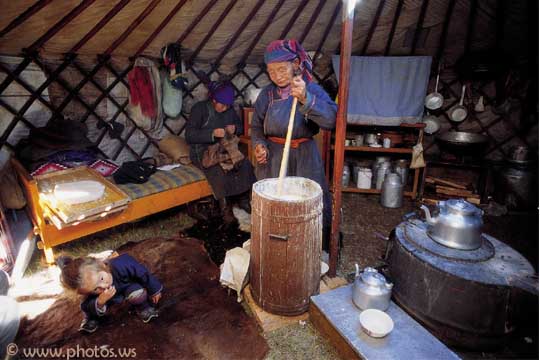
Sour milk here is fermented mare's milk or koumiss (Turkish qumyz, or in Mongolian variously esüg, airag, or chigee), a lightly alcoholic drink, which was used to replace wine in the king's non-Paschal Eucharist (the photo shows koumiss being churned).

The fact that Mari ibn Suleiman, the earlier source, does not link this story to the Kereyid is important. When Bar Hebraeus was writing, the Mongols ruled the Middle East and the queens of the Kereyid (who had been defeated and conquered by Genghis Khan in 1203) were famous as patrons of Christianity. It is likely that Bar Hebraeus writing in the thirteenth century decided that the Christian king of the Turks must be of the Kereyid, who were a kingdom in what is now central Mongolia, close to the country's current capital of Ulaanbaatar.

In fact, however, the king in question is almost certainly not of the Kereyid, but of the "White Tatars" or Önggüd, a people living south of the Kereyid in present day Inner Mongolia in China. The Önggüd were the most staunchly Christian people of the Mongolian plateau in the thirteenth-fourteenth century, and the name Sergius (in the Turkish form Sergis~Sirgis) is well attested among them. Although part of the Mongol empire, they long retained their Turkish language. The story of St. Sergius appearing to the lost king was retold in the fourteenth century, by the Confucian literatus Yuan Haowen. Writing a memorial epitaph for the grave-stie of a distinguished Önggüd literatus, Ma Qingxiang, he repeated the story. In his version, the Christian saint appears as a kind of Buddha, and the king is not the king of the Önggüd, but the emperor of the Jin dynasty (A.D. 1115-1234), who were the liegelords of the Önggüd kings, and ruled North China. (The Jin was founded by the Manchurian Jurchen, ancestors of the later Manchus) . In this version, the Önggüds, having been deported and exiled to Manchuria by the Jin founders are released as an act of merit by the second emperor of the Jin dynasty, whom the Önggüd then serve loyally in Inner Mongolia. (Later their prince deserted to the Mongols, and they became marriage allies of the Mongol khans of China.) It is fascinating to see how Yuan Haowen takes the story and modifies it, making the central issue that of the identity of the image, and the spiritual redemption of the Önggüds into their political redemption by the emperor. Here is the text of the beginning of Yuan Haowen's funerary inscription for Ma Qingxiang:

Qingxiang, whose courtesy name was Ruining and family name Ma, and who had another courtesy name of Sirgis was a member of the aristocracy of Huamen. In the time of Xuanzheng [this is hard to interpret but appears to mean rought around 1120 AD], his tribes-people were settled at Didao of Lintao [in Gansu, northwest China] and had lost trace of their origin. When the Jin armies invaded western Shaanxi [near Gansu], the whole group was transported to Liaodong [eastern Liaoning, in southern Manchuria] where they remained. Once when the Great Ancestor [honorific title of the second emperor of the Jin, 1123-1135] went out on a hunting expedition, he thought he saw a golden man walking along with the sun clasped to his bosom. He was much excited and did not dare to gaze upwards. He gave up the hunt and returned, and commanded that a search be made of what he had just seen. It was thought by some that what the Emperor had witnessed was the personification of the Buddha. As there were no Buddhist temples or pagodas in Liaodong, a Buddhist likeness could not be obtained except in the building where the fanbai [scriptures] were chanted by a Turkestani [commonly used in Chinese at the time for Middle Easterners as well]. Hence, a painting was taken from them and presented to the Emperor; this actually agreed with what he had seen. The Emperor was delighted. He sighed with relief and ordered that an appropriate recompense be made (lit: that a field be planted with blessings). All tribesmen held as captives were amnesties and became ordinary commoners. They were provided with funds and released. Mr. Ma’s grandfather was Temür-Öge., and his father’s name was Bar-Saoma Elishu. They moved to Tianshan in Jingzhou [in central Inner Mongolia], where they have been recorded and lived for generations. (Adapted from Chen Yuan, Western and Central Asians in China Under the Mongols: Their Transformation Into Chinese, trans. Ch’ien Hsing-hai and L. Carrington Goodrich (Los Angeles: UCLA, 1966), p. 44-45.)

Despite the acceptance of it shown by the Church of the East, fermented mare's milk would be a flash-point of religious conflict in the Eastern Orthodox tradition in later centuries, marking off the sedentary Christian from the nomadic infidel.

Labels:

|

Saturday, November 26, 2005

Why the Jews Don’t Try to Ban Piglet

The pig is having hard times in England these days. Muslims and sympathizers have decided that public display of porcine affection (PDPA) is an insult to their faith. (The original news story is here, and there’s commentary here).

What’s the dog that didn’t bark in all this? Well, this isn’t the first time a region or city has seen a big advance in the demographic representation of people who don’t like pigs. The Jews are a large percentage of the population in many urban and suburban areas of the United States. How come New York City or Palm Beach employees never had to exile Piglet from their cubicles?

One could, of course, point to the presence of a large and vocal secular presence in the Jewish community, for whom pork products, suitably stir-fried, are the very sign of liberation. But even religious Jews, while of course excluding the pig from their homes, don’t seem to mind PDPA in their Gentile neighbors. Why is that?

It is because Judaism explicitly distinguishes specifically Jewish rules of righteousness from universal human rules of righteousness. The latter are limited to the Noachide laws, derived by Rabbinical speculation from Genesis 9:1-17. The distinction of clean and unclean animals is seen as a specifically Jewish rule, not binding on the rest of humanity.* The same is true of the Jewish calendar, the Hebrew language, the ritual practices of Judaism -- all are restricted to Jews alone, the religious requirements for Gentiles being simply monotheism and renunciation of idolatry. In this sense, Judaism distinguished natural, trans-cultural religious truth (in the rather watered down form of seven laws) from the specific revealed religious truth of the laws (and oral tradition) of Moses. Following the words of the prophet Jeremiah ("Seek the peace and prosperity of the city to which I have carried you into exile. Pray to the Lord for it, because if it prospers you too will prosper"), religious Jews outside of Israel draw strict boundaries between their own conduct and that which they expect of their Gentile neighbors.**

Islam, by contrast, insists that it is a universal, natural religion, more or less incumbent now on all humanity. (Past prophets were valid in their day, and followers of their revelation can be tolerated today, but really followers of Moses, Jesus, Adam, and so on ought to see that Islam is the corrected and completed form of their faith). As a result, the Islamic food laws, the Islamic lunar calendar, the Arabic language in which the Koran was revealed, the specific postures and Arabic words of Islamic prayer: these are not just something for one religious community and one nation, but for all. Thus pork is not just something "we Muslims" don’t eat, it is something that really no one should eat, even if out of the generosity of Islam its private consumption is allowed to the benighted. Much of the peculiar nature of Islam from the Jewish or Christian perspective is its insistence on things that seem so clearly culturally relative (food, calendars, specific prayer forms, etc.) are in fact part of the natural religion of humanity. As Alain Besançon argued in this fascinating article (unfortunately not available free on the web -- I highly recommend you dig it out in print), it is the peculiar relation of Islam as a revealed natural and universalized particular religion that makes it different from either pole of the Christian-Jewish continuum.

Christianity recognizes the same disjunction between the laws of Moses and the laws of Noah (even if we hesitate to codify the specific seven Noachide laws) that Judaism recognizes. The difference is, is that the Christian religion refuses, or should refuse, to make salvation dependent on religious culture, while still being a true religion, rather than the purely abstract, bloodless natural religion of Judaism's "Noachide religion." This is the heart of Paul’s revelation about Christian liberty and both his teaching and the "Noachide laws" are differing reactions of parochial Judaism to the wider world of Greco-Roman culture. Unfortunately, Christianity has often back-slid into designating particular foods, or calendars, or prayer forms as incumbent on all mankind. The Eastern Orthodox church, for example, declared fermented mare’s milk (Turkish qumyz or Mongolian esüg or airag), part of the staple diet of the Central Eurasian nomads, to be unclean, something that caused great hardship for Christians in the Mongol empire, and made conversion to Orthodoxy essentially impossible for Turco-Mongol nomads.

Even more strange -- and dangerous -- is the tendency in some corners of the Reformed world to adopt the laws of Moses as the positive code of Christian life. If we take the laws of Moses and universalize them, then the Christian church becomes Joshua’s Twelve Tribes and the whole world becomes Canaan. The result is a universal duty of iconoclasm, of destruction and replacement of the unclean idolatrous inhabitants with the clean Biblical ones.

*Curiously, though, the distinction of clean and unclean animals is found in the account of the flood itself (Gen. 7:2-3), which would suggest the clean vs. unclean food has some universal basis. This ambiguity at least in phrasing -- were pigs really unclean before and then cleansed by an act of God, or was their uncleanness never more than a special command of God? -- is continued in the New Testament; compare Mark 7:14-23 with Acts 10:9-16.

**Judaism also restricts a number of Mosaic laws to the Promised Land itself. For example, in Rabbinic interpretation, the laws on releasing debts in the Jubilee year or leaving fields fallow every seven years, and the attendant divine promises, are valid only in the Land of Israel. Jewish farmers or businessmen in Ukraine or America are not expected to follow these laws and have no promise of plenty if they do. Thus it is also true that religious Judaism in the Land of Israel is far less tolerant than it is in the lands of exile. PDPA can be pretty risky in some Jewish quarters of Jerusalem!

Labels:

|

Monday, October 17, 2005

What is Christian Liberty For?

Over the summer I was reminded of how central "Christian freedom" is to cultural praxis among Christians today and how carefully this intensely powerful doctrine must be used, by the notorious cremation wars on Bunnie Diehl’s weblog (see posts 1, 2, 3, 4, 5, 6, 7, 8, all with long comment strings), and an article (now only available for pay) in Leadership discussed by the iMonk. I was reading Nick Lane’s Oxygen: The Molecule that Made the World and I was struck by his refrain that oxygen as a molecule is simultaneously the most powerful energy source for life, yet also in untreated form a ferocious toxin. Handling, buffering, transporting, and yet finally releasing the awesome energy bound up in oxygen’s electron-grabbing power is what life is, chemically, almost all about. The same is true for liberty in the Christian life.

The first question is, what is Christian liberty for? Let’s go back to Paul. Paul’s teaching of Christian liberty, as enunciated in his famous chapters in Galatians, 1 Corinthians, Romans, and Colossians, is primarily occasioned by the need to integrate two different cultures in one church: Jewish and Gentile. (This is not to say that cultural integration within one church is the only possible use of Christian liberty, but that was the occasion for its scriptural enunciation.) These two cultures differed in their calendar (Jews observed lunar months and sabbaths [i.e. Saturday], while Gentiles had only the Roman solar calendar and pagan festivals), eating habits (Jews had access to kosher butchers and could eat meat, but Gentile Christians had access only to pagan butchers who dedicated their victims to the pagan gods and hence found meat-eating problematic), and bodily care (Jews circumcised, Gentiles didn’t).

Paul attacks at length the most obvious wrong "solution" to this bicultural church: take the customs of the older brothers in the faith and make them normative for the new Gentile Christians as well. This is the Judaizing trend. This is where Paul does most of his theological heavy lifting. Food, drink, calendars, rituals such as circumcision - - all of these items which together make up what anthropologists define as culture - - are declared irrelevant to righteousness. Culture is excluded not just from justification (even common human morality, known to all, is excluded from that) but also to sanctification, in which the commandments of God are central.

At the same time, however, Paul explicitly rejects the other posssible solution: impose the freer, less ritualistic cultural pattern of the majority culture on the over-scrupulous minority. He thus explicitly allows the continued observance of Jewish cultural practices by Jewish Christians: circumcision, and observance of Saturday sabbath in addition to the Sunday church meetings. But Paul’s approval is conditioned on 1) relativizing these rituals as a part of Jewish religious culture, not absolutizing it as a moral commandment, and 2) on it being practiced only by those for whom it was communally appropriate; i.e. Jewish Christians.

Thus Paul divides religion into three elements: 1) faith in Christ which is beyond culture and absolute, and which alone is involved in justification; 2) the law or works, which is likewise beyond culture, determined by the intent, not the outward act, but which is involved only in sanctification, not justification; and finally 3) religious culture. This category (a.k.a. adiaphoron in Lutheran theological debates), involves outward acts of eating or not eating meat, drinking or not drinking liquor, resting or not resting on Saturday, or circumcising or not circumcising one’s boys. Religious culture is relative to particular Christian subgroups (as defined by ethnicity), and is not part of the commandments but is - - and this is the part too often missed - - a mode of expressing in one’s bodily works the commandments of God. Thus one man may eat to the Lord, giving thanks, or abstain, giving thanks as well. Contrary to popular interpretation, Paul is not hostile to religious culture as such. Uncircumcision is no more holy than circumcision, but neither is anything in sanctification.

Since, however, each culture expresses in its religious culture these commandments in somewhat different ways, Paul had to warn against "short circuits" in which an act meant one way in one cultural context, is wrongly interpreted by other Christians according to another cultural context, and so seems to violate or misunderstand the commandments of God. Paul’s path for the bicultural church thus demanded for its working an explicit consciousness of culture as culture, as something separate from religion and the commands of God. Gentile Christians had to be aware that their Jewish brothers observing a sabbath were doing so not as an observance of the sabbath-keeping commandment, but in observance of Jewish culture (otherwise Jewish culture will be imposed on Gentile culture). Jewish Christians likewise had to be aware that Christ’s abrogation of the sabbath as a type of His rest did not mean that sabbath-keeping was inherently wrong (otherwise Gentile culture will be imposed on Jewish culture). Paul’s prime concern was not the preservation of culture for its own sake (although he certainly was a proud and patriotic Jew), but the preservation of the distinction between culture and what he calls the law of Christ or the commandments of God. Practically, a right understanding of what the Law is or isn’t required early Christians to preserve the bi-cultural nature of the Christian community.

Unfortunately by around AD 400, this sophisticated theory of culture and morality had been largely abandoned. In place of the bi-cultural model of Christian religious life that separated religious culture from the commandments of God, a new enculturated form of the commandments of God was made obligatory on all Christians. This time, however, the community doing the imposing was the Gentile Christians. The clearest sign of this new monoculture was that circumcision and Saturday sabbath-keeping were declared un-Christian. Jerome’s commentaries on Paul’s epistles codified the new reading in which Paul had really been making only temporary concessions to Jewish Christians, and that the law of Christ really meant the compulsory adoption of Gentile Christian religious culture. This religious culture, precisely because it was a religious monoculture could not longer be distinguished from the commandments of God. Since all Christians had the same ways in food, drink, time regulation, and treatment of the body, none of these things, which together make up culture, could be easily distinguished any more from God’s universal morality. Paul’s teaching of Christian freedom essentially disappeared, because in a monocultural Christian world, its original function had become obsolete.

By the late Middle Ages, however, the teaching of Christian freedom came up again, but in a new context. Here, it was the distinction between those things commanded on the authority of God and those commanded on the authority of the church, particularly the Pope. Late medieval theologians were virtually unanimous is saying that while the Pope could make rules of good order (contempt of which was a sin), he could not actually make new divine commandments (see more on this topic here). To violate what the Pope commanded was not inherently sinful in the way that violating a divine command was (such as blaspheming or stealing). The moral sin in violating the commands of the Pope was simply despising the Church as a moral authority. Despite this seeming clarity, however, the late medieval church was seeing a vast upsurge in knowledge of church history which rendered it unclear on what basis any given prohibition was based. Communion in one kind, priestly celibacy, marriage as a sacrament, the distinction of bishops and priests: papal prohibition or apostolic command? Arguments on both sides raged in the fifteenth century.

Luther’s assertion of Christian liberty thus had four primary points. First, it was part of his recovery of the Gospel to reemphasize that neither law nor religious culture had any role in justification. This well-known first step in the dethroning of religious praxis from one’s standing before God did not directly involve any distinction between the commandments of God and religious culture.

Secondly, Luther used the on-going recovery of church history and his own reading of Scripture to argue persuasively that on virtually all the disputed church issues, the party arguing for a post-apostolic innovation were correct.

Thirdly, Luther used Paul’s concept of religious culture before his excommunication to relativize papal commands and develop a way for evangelicals to live within the Catholic Church. Before 1521, he treated communion in one kind, for example, on the analogy of Paul’s treatment of circumcision: some may do it as their tradition, but it is in itself an indifferent matter. While the Hussites should be allowed to take the cup because that has become their own Czech tradition, German evangelicals should accept that they will be deprived of it. Observing or not observing such traditions was not part of God’s commandments but instead part of the religious culture in which they had grown up and as such morally indifferent. While Luther treated such observances as something to be tolerated, he saw positive church legislation on the question to be illegitimate and an usurpation of power. After his excommunication, Luther revised his opinion on some aspects of religious culture, shifting communion in two kinds, for example, into the divine command category. But the concept of religious culture (what at the time was called adiaphoron) was still relevant: Sunday rest, the liturgy, religious art all fell into this category.

Fourthly, and perhaps most importantly, Luther explicitly repudiated Jerome’s reading of Paul, rejecting his assertion that circumcision for Messianic Jews had become unlawful under the New Covenant. Essential to Luther’s claim that the law which Paul had criticized as death-dealing was exactly the moral law, this avowal that the practice of Jewish customs as customs was licit in the New Covenant, was unfortunately not followed up. For historical reasons, Christian religious culture remained largely a mono-culture, to which new converts, Jewish, American Indian, or African, were expected to convert. But the doctrine of adiaphora and Christian freedom established, however theoretically, a difference between religious culture and the commandments of God, and a reestablishment of the principle that the church may recommend, but not command, the former.

Scrolling forward to the late twentieth century, one would think we are now experiencing a new birth of Christian freedom. Cultural differences and cultural preservation are being validated as an inherent good as never before. Consciousness about cultural differences and cultural relativism is at a high level. Messianic Judaism as a movement that self-consciously refuses any more to blend into the Gentile Christian mainstream has made the issues Paul raised in his letters salient once more. Yet ironically, the teaching of Christian freedom that is deployed supposedly to validate cultural diversity I contend has the practical effect of destroy cultural specificities and establish a world-wide Christian mono-culture: informal, egalitarian, democratic, and unfilial, prizing "authenticity" and "sincerity" above all. To follow the analogy I started with, something has gone wrong in our cellular chemistry, a chemical chain has been broken and the powerful yet lethal free radicals have been cut loose from their chemical holding pens and are now rampaging around inside the cell, turning long-standing cultural DNA into un-decipherable junk.

If you read the articles I linked to above, you will notice that both turn centrally on a type of issue which did not concern Luther or Paul: what happens when people within a culture (as defined by ethnicity/ancestry) begin to challenge that culture’s symbolic meanings (not church ordinances). One involved the issue of baseball caps in church: some boys, with their parents’ support, wanted to wear them into church after sports practice. The pastor assented, citing "Christian liberty", the other church members objected, the pastor eventually asked the boys to make peace by complying, and the boys’ family left the church in a huff. The other involved cremation vs. inhumation (burial) and turned on whether there was or was not some inherent link between the symbolism of inhumation and the doctrine of the resurrection. In both of these conflicts, we have a symbolic action which has traditionally been strongly linked to a belief in Christian European culture (doffing the hat signals respect, burying the body signifies "sleep until the resurrection"). We also have a party, however, who reject that symbolic equation and insist that the symbolic action does not actually have any definite meaning at all. Wearing a baseball hat in church means . . . exactly nothing. It may mean disrespect to you, but it doesn’t to me, and Christian freedom means you should not impose your scrupulous interpretation of it on me.

The practical result of this reasoning is to make cultural difference illegitimate. How so? We need to remember first that culture is inherited symbolic meanings and classifications. For examples, in American culture dogs are pets, pigs are farm animals, and pets are not eaten, while farm animals are. In Korean culture, dogs and steers are both farm animals, and farm animals are eaten, and so both are eaten. Despite what Americans think, there is no rational basis on which the allocation of the dog to the pet category can be defended. Roughly speaking, dogs and cattle are equally intelligent, social, sensitive to pain, and so on. If you ask, why can’t we eat dog meat, no answer can be given, except the we just don’t do that answer. And this appeal is essentially an appeal to antiquity understood as authority: we haven’t done it that way. In other words, a particular culture is preserved only if the younger generation can be persuaded or compelled to adopt the symbolic meanings and classifications given by the older generation.

At this point the first conclusion is clear: while Paul’s version of Christian freedom was intended specifically to allow Jewish and Gentile elders in the church to enculturate their juniors while maintaining unity as Christians, the contemporary version of Christian culture is intended to prevent elders in the church (of any culture) from enculturating their juniors, and hence preserving, their religious culture. This block on enculturation is held to be necessary for Christian unity. (Elder here is used not in any specific church office sense, but simply in the literal sense.)

Now one might think that if no culture is imposed, then won’t cultural diversity increase? But to think so would be unpardonably naive. Let’s go back to the dog and steer comparison. Recently Korean youth have begun to classify dogs as house pets and find eating dog meat repulsive. Americans have not yet, however, come to feel that steers are pets and that eating them is repulsive. One might wonder why this is so - - is it confirmation that dogs are inherently less edible than steers (in all but brute size)? Hardly: it is confirmation that the United States is bigger, richer, and has more cultural "gravity" than Korea.

This is the missing factor in the cremation and ball-cap debate. Contrary to the "play dumb" attitude of those playing the "Christian freedom" card in these cases, nobody just ups one day and says, "I see no logical reason why wearing hats equals respect; it is arbitrary and therefore it is contrary to Christian freedom for me to follow such regulations." Rather culturally significant decisions are made for reasons. Some people wear ball caps in church to project a particularly look (or to put it differently, to identify with a set of symbolic attributes associated with attractive forms of power and respect.) Some people adopt cremation because they want to show the world they don’t believe in the resurrection. Others wear ball caps because otherwise their hair would look unattractive. Others adopt cremation because burial is more expensive. For whatever reason, the fact is cultural signs are negated, dogs are treated as pets, kids wear ball caps in church, people ask to have their bodies cremated for reasons, reasons in which the assymetrical power relationship between communities (such as powerful and wealthy celebrities vs. odd, slightly goofy church people) play a key role. The cultural playing field is tilted, and to prevent the elder generation from enculturating the juniors is to ensure the domination of the wealthier, more self-confident of the cultures available. Ironically the result of this new deployment of "Christian freedom" is to create exactly the kind of Christian monoculture which Paul’s deployment of Christian freedom was intended to prevent. Whether the small culture is Lutheran liturgical worship adrift in a sea of megachurches with guitars, or Omahas trying to interest their children in their language, the cultural race will inevitably be to the strong if "Christian freedom" is deployed to abrogate any right of elders to expect their youth to conform.
So what are the lessons?

1) Christian freedom is first and foremost a freedom to conform, to conform to the powers that be in your bodies without conforming in your soul.

2) Ethnocentrism is indeed a problem—identifying one’s assimilated religious culture with the commandments of God—but not the most fundamental one: the most fundamental one is to assume that "divinely commanded" and "entirely arbitrary" are the only two possibilities. If that’s true, then the alternative to ethnocentrism is a nihilistic skepticism about cultural practice, which in turn offers no check toward gravitation to the lifestyles of the advantaged, whether by wealth, by knowledge, or by freedom. This in turn leads to the monoculture that ironically feeds a new ethnocentrism.

3) Hence, the proper deployment of Christian freedom demands awareness of culture, and especially of religious culture, as something that is not a divine command, and yet is capable of being an expression of ethical action. That cultural reflexivity is difficult, if not impossible, to nurture in the absence of multiple cultures coexisting within the Christian church.

Labels: ,

|