Free Market, Pro-Growth, and Pro-Business: These Aren't the Same Thing
One thing that the Crunchy Con debate has reminded me is that supporting a completely free market and supporting economic growth are not the same thing, and neither is the same as being pro-business. They're related, sure, but not the same.
Rod Dreher's Crunchy Con manifesto has the following article:
"3. We affirm the superiority of the free market as an economic organizing principle, but believe the economy must be made to serve humanity's best interests, not the other way around. Big business deserves as much skepticism as big government."
Now reviews I've seen have taken this as a mere concession to the "free-market Right", what you've got to say to remain still a conservative. But I don't think that's necessarily the case, and that's clear if you go back in American history to look at the conflict between the Jeffersonians (and their belligerent half-brothers the Jacksonians) and the which of the party of Hamilton and Lincoln.
Which one of these was the party of big business? The Whigs, most definitely. Which one was the party of the free-market, no deficits, and keeping government out of the economy? The Jeffersonians, actually. The Whig program was based on the idea that in order to get growth, and the kind of mobile, thriving, commercial, urban society that was their ideal, one needed the government to prime the pump, by building canals and railways, by chartering a national bank, by giving away federal land to homesteaders and corporations on favorable terms, and using federal power, and federal courts, to kick the doors open that localities might want to keep closed.
As Allen Guelzo's brilliant biography shows (excerpt here), Lincoln himself was a corporate lawyer, whose main business was forcing railroads on unwilling towns: the sort of lawyer who today files suit to bully city councils into dropping their ordinances against Walmart. He had grown up in southern Indiana on the farm of a real crunchy con, a Hard-Shell Baptist who deployed his family as farm hands to grow everything he needed at home and barely participated in the cash economy. When Lincoln later came face to face with slavery, he thought it looked familiar: bondage, without any process of betterment or freedom from a hard-fisted patriarchal tyrant. The battle against black slavery for him was one with the battle to open up isolated towns and hamlets to the progress brought by industry and commerce, and both should be supported by the government. To him, banks -- the prime thing philosophical Jeffersonians and rabid Jacksonians were alike in hating -- were good, not bad, or at least as good as any other human instrument of progress.
And the Rooseveltian progressives shared that love of the national market as part of progress. Unlike Lincoln and the Whigs, however, they didn't and don't like the idea of the government giving advantages to business and then letting the businesses reap the profits. No, the government should take a big share of the direction, investment, and the profits that accrue from growth. Build roads and canals and railways and dams? The Whigs and the Rooseveltian progressives say, yeah! But they differ on how to fund and control them.
Today, American business is much more developed. Tariffs -- long the speciality of the Whig-Republican program -- are no longer needed to keep out foreign goods, since capital is global. In many spheres, America's highly competitive businesses just want to be let alone. So the Whigs in the Republican party today find free-market, laissez-faire rhetoric to be mostly in their interest. But make no doubt about it: the country's Chambers of Commerce are not interested in free-market principles or small government, they are interested first and foremost in growth. If anyone is interested in small government as a principle, it's the Jeffersonians.
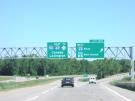
In southern Indiana we have a prime illustration of this: the long-planned highway I-69. Originally I-69 had the support of Indiana's business and labor communities, in other words, the Whigs and the Rooseveltians. The labor-supported Democratic governor Frank O'Bannon was a big supporter, as were the rock-ribbed Republican mayors and city councils in towns like Evansville and Martinsville. Only the Bloomington City Council, solidly in anti-growth Social Democrat hands, was negative. Yet everywhere a scattering of local conservatives were worried both about the massive spending needed and the tearing up of more agricultural land and the use of eminent domain to take over rural homesteads and farms: classic Jeffersonian concerns. The Christian conservative Eric Miller opposed I-69 for exactly these reasons.
But he was defeated in the primary in 2004 by "My Man" Mitch Daniels, fresh from the Bush cabinet and a classic Whig or "mainstream conservative." Now in office, he has reached back into the old Hamiltonian-Lincolnian bag of tricks and come up with his "Major Moves" plan: leasing the already existing northern branch of I-69 to Spanish-Australian consortium, in exchange for $3.85 billion to fund road construction, including the southern branch of I-69. It's a classic Whig public-private deal to generate growth and profits, supported by all the usual Whig suspects: the realtors, the chambers of commerce, and of course the Republican legislators. But the idea of leasing the road (along with the need to oppose the Republican governor -- partisanship operates independently of ideology) has thrown the Rooseveltian big-government progressives in the unions (with the exception of the always pragmatic Teamsters) and the Democratic party back into alliance with the Social Democratic anti-growthers and the scattered Jeffersonian agrarian conservatives. The Democrats all voted against the "Major Moves," but Mitch Daniels' Whig Republicans had the votes and pushed it through on a party line vote.
Who was "free market" in all this? If "free market" means the government seeing it as a matter of indifference whether new roads get built or not and whether the economy grows or not, then it was the opponents of I-69 who were the real free marketeers. Who were the "conservatives" in this? It depends on how you define it. I think we can agree that the Bloomington city council's plan of following Richard Florida's ideas to replace industrial jobs with creative singles, gay-friendly businesses, and bohemian progressives who are attracted to a hip college-town environment is not conservative. But this unconservative program is the only one that has a fighting chance to get Wendell Barry-style Jeffersonians the anti-growth policies they need to survive.
When it comes to Jefferson vs. Hamilton, both are so in-bred into the American genome, that saying this or that is "really" conservative is pointless. I-69 is an example of the kind of debate that Americans have been engaged in right from the beginning.
Labels: American society, Conservatism, Lincoln
posted by CPA at 9:27 AM


