Sunday, January 20, 2008

How Does One Come to Believe the Gospels?

How does one come to believe in the authority of the Bible? A comments thread here offers some remarkably helpful (for a comments thread, which is an undemanding measure) thoughts that match my own experience. We say Scripture attests to Jesus and Jesus attests to Scripture, which sounds circular. But it’s not, because the attestation works differently in the different steps of the argument. Three steps may be distinguished.

First one decides that the Biblical account is plausible; that is, that it is more or less reliable, the same way that Thucydides is more or less reliable on the Pelopennesian war or Teddy White on the election of 1960*. In this stage, one puts the source into the witness box, so to speak, and is not shy of cross-examining it for contradictions. On the other hand, as is pointed out by Clare** and Cooky642*** in the comments thread, multiple witnesses of a single event can actually be more convincing if they have slight discrepancies. Given the well-documented vagaries of eye-witness testimony (more here and here), two witnesses will probably produce exactly the same account only if they have gotten together to “get their story straight” before hand. In this stage then, small discrepancies can actually add to the reliability of the points the witnesses do agree on, particularly if these discrepancies stem from some obvious difference in background, temperament, or position of the witnesses. Human qualities in the witness are appreciated, not deprecated. Insisting on inerrancy in this stage is not only unnecessary, but actually hampers belief, because an inerrant witness is too unusual to be believed in, and would need a separate witness himself, and so on in infinite regress. Moreover the marks of inerrancy are too similar to the marks of a coached and cooked up witness’s story not to be suspicious.

The second stage comes when one realizes that these ordinary, prosaic, all-too-human witnesses are describing something truly beyond ordinary human experience. Four ordinary men are testifying to a man who was/is God. The stories of the four witnesses vary according to their to their backgrounds, temperaments, and points of view, but what they agree on is that He did miracles while alive, that the tomb was empty, and that He rose from the dead. A finite witness is encompassing an infinite reality. And this infinite reality asks for belief from you.

The third stage comes when one realizes that the witnesses themselves are playing a part in this divine reality’s plan to come to you. At this point one wants to know as much as possible about the Man to whom they are testifying. The clearer their testimony the clearer one comes to know Him to Whom they testify. And one of the things that the witnesses consistently testify to (in their different ways) is that they have been chosen by Him to bear witness to Him, and that their testimony will be trustworthy. Suddenly, we have a plausible witness making a plausible statement that they heard the divine Man designate these witnesses as men of unquestionable authority. And if that’s the case, then they are more than just human witnesses, rather they are divinely commissioned Apostles. The Apostles as witnesses gave plausible testimony to Jesus as Son of God, and now the Son of God gives irrefragable testimony to the Apostles as inerrant teachers. The authority of the New Testament is thus established.

This is how it happened for me. From my first acquaintance in my teenage years, the four Gospels seemed to be a fairly plausible account of what happened in the life of Jesus, far more plausible than the Dan Brown-style accounts vying with it, all of which reeked of ex post facto hagiography, special pleading, and cooked-up testimony. But I never believed them as the Word of God, until I came to grips at age thirty with the Man that they bear witness to. From then on, the Gospels were not just plausible, but the guide to life, the inerrant witness to the Man we all must know as well as ever we can.

The problem though is, what to do with those small discrepancies that had previously been helpful in establishing the untampered-with authenticity of the four witnesses? If the witnesses are indeed divinely commissioned, they shouldn’t make any errors, right? And couldn’t one bring people to believe in Jesus more rapidly if you could start from the beginning by asserting divine authority for these four witnesses?

That is of course the way many in the church have taken. It is the origin of the idea of harmonizing the four Gospels. In the churches of the Roman Empire, the four Gospels were always read separately, but in the Church of the East in the Persian Empire, from AD 170 to later than 350, the standard Bible was the Syriac translation made by Tatian called the Diatessaron, and arranged not as four Gospels, but as a read straight-through harmony. Even in the Greco-Roman churches, centuries of harmonization have made it very difficult for us to read, for example, Luke’s account of the angels announcing the nativity to the shepherds apart from Matthew’s account of the visit of the Magi.

At the same time the Church has resisted canonizing any one harmonizing scheme. The Church of the East eventually gave up the Diatessaron in favor of the four separate Gospels. So the cleansing of the Temple in the beginning of Jesus’s public preaching career according to John and the cleansing at the end of it in the Synoptics have been just left side by side, for Christians who confess the inerrancy of Scripture to solve as they will. Luther preached on John 2:13-16 thus (in part):

In John’s Gospel the cleansing of the Temple appears to come directly after the baptism of Christ, whereas in Matthew’s Gospel it comes after the entry into Jerusalem on Palm Sunday. It is not important to settle this question. It may be that John has jumped over the entire interval from the beginning of Jesus’s ministry to the last Passover because less interested in the deeds than in the words of Christ. Be that as it may. If you cannot contrive a reconciliation of John and Matthew, let it go, You won’t be damned on that account. (See Roland H. Bainton, Luther’s Meditations on the Gospels, p. 93).

It seems to me there is wisdom in thus keeping the Word both open to those outside and to those inside. To those outside, the Gospels must remain plausible historical documents. The outsider cannot believe (yet) in inerrant witnesses, because he has never met any. But he can believe in reliable witnesses because he has come across such in his living experience. Let the Gospels be that for him then. Do not try to harmonize them, do not try to “get our story straight” and then stubbornly tell the world, “that’s my story and I’m sticking to it.“ But do insist that the Gospels are a reliable guide to the life of Jesus of Nazareth and that Acts tells the story of the Church at least as well as Herodotus tells the story of Thermopylae.

But to those inside, the Church must confess the Word as the norm, as the guide of spiritual life, and also as the accurate exposition of the knowledge of the life of Jesus and how the Spirit founded the Church. And if it is wrong, then it would be a blind guide. So to us inside, we have to confess the Scriptures are the infallible words of divinely commissioned Apostles teaching us of Jesus. If you prove to me the Gospels say this or that, then I have to believe this or that or be a disobedient son. And when will we prove to the outsiders that the Bible is indeed inerrant and that the solution to the problem of the different dates of the cleansing of the Temple -- the solution Luther didn’t have and I don’t think anyone else has either -- was obvious all along? When the world is the Church and the Church is the world.

(To be continued)

*Randy Gritter in the comments thread referred to above puts it this way (with a Catholic spin):
Catholics make 2 passes at scripture when they try and provide the rational basis for their faith. The first pass just requires scripture to be generally historically accurate. Then you can conclude that Jesus lived. That he taught certain things. He did miracles. He died. He rose again. He established His church.

Then once you have all those historical events established you can look at the church as the body of Christ and conclude that it must be right when it defined the cannon of scripture. So Mark is right. At this point in the argument you don't need to show scripture is inerrant. You just need to show it provides solid reasons for believing the events described.


**Speaking as a lawyer, a story can actually be more believable when the witnesses don't totally agree on every single tiny detail. If you get a bunch of eyewitnesses to an event that corroborate each other 100%, it's suspicious, since it looks like they've all been coached. When you get a group of honest human beings together, and ask them to recall something that happened, their answers are naturally bound to vary a little bit. But it's only when they vary on the most basic points--"yes, it happened," vs. "no, it didn't"--that the event is called into question.

***Has anyone ever had the experience of witnessing a disaster or even just a traffic accident? If so, you'll know that the police who respond question everybody who witnessed the event. Why? I asked, once. The answer was that everybody who saw what happened saw it from a different angle, and with differing levels of attention. The job of the policeman is to take down all the stories and then evaluate them to see where they agree. Then that's what probably actually happened. Among the divergent memories may be clues to solve the mystery of why it happened.

Labels: ,

|

Saturday, January 05, 2008

An Epiphany Midrash

By chance it happens that this Sunday falls on the date of real Epiphany, January 6. While Epiphany was originally the date assigned to Christmas in the Greco-Syriac parts of the Christian world, it has now come to be associated with the visit of the Magi to the Christ child.

In honor of this occasion, I would like to reproduce a story from Marco Polo (in Ronald Latham's translation), a travel writer who gets far less than his deserved respect. Make of it what you will:

Now let us leave Tabriz and turn to Persia, a very great province and at one time a very splendid and powerful one, but now ravaged and devastated by the Tartars [i.e. the Mongols, who conquered Iran in the thirteenth century].

In Persia is the city called Saveh, from which the three Magi set out when they came to worship Jesus Christ. Here, too, they lie buried in three sepluchres of great size and beauty. Above each sepulchre is a square building with a domed roof of very fine workmanship. The one is just beside the other. Their bodies are still whole, and they have hair and beards. [Post-mortem incorruption is a vital sign of sanctity in all medieval religions.] One was named Beltasar, the second Gaspar, and the third Melchior. Messer Marco asked several of the inhabitants who these Magi were; but no one could tell him anything except that they were three kings who were buried there in days gone by. But at last he learnt what I will now tell you.

Three days farther on, he found a town called Kalah Atashparastan, that is to say Town of the Fire-Worshippers. [That is, town of the adherents of the Zoroastrian religion, the pre-Islamic religion of Iran. Magus is in fact the name for Zoroastrian priests.] And that is no more than the truth; for the men of this town do worship fire. And I will tell you why they worship it. The inhabitants declare that in days gone by three kings of this country went to worship a new-born prophet and took with them three offerings -- gold, frankincense, and myrrh -- so as to discover whether this prophet was a god, or an earthly king or a healer. For they said: 'If he takes gold, he is an earthly king; if frankincense, a god; if myrrh, a healer.' When they had come to the place where the prophet was born, the youngest of the three kings went in all alone to see the child. He found that he was like himself, for he seemed to be of his own age and appearance. And he came out, full of wonder. Then in went the second, who was a man of middle age. And to him also the child seemed, as it had seemed to the other, to be of his own age and appearance. And he came out quite dumbfounded. Then in went the third, who was of riper years; and to him also it happened as it had to the other two. And he came out deep in thought. When the three kings were all together, each told the other what he had seen. And they were much amazed and resolved that they would all go in together. So in they went, all three together, and came before the child and saw him in his real likeness and of his real age; for he was only thirteen days old. Then they worshipped him and offered him the gold, the frankincense, and the myrrh. The child took all three offerings and then gave them a closed casket. And the three kings set out to return to their own country.

After they had ridden for some days, they resolved to see what the child had given them. They opened the casket and found inside it a stone. They wondered greatly what this could be. The child had given it to them to signify that they should be firm as stone in the faith that they had adopted. For, when the three kings saw that the child had taken all three offerings, they concluded that he was at once a god, and an earthly king, and a healer. And since the child knew that the three kings believed this, he gave them the stone to signify that they should be firm and constant in their belief. The three kings, not knowing why the stone had been given to them, took it and threw it into a well. No sooner had it fallen in than there descended from heaven a burning fire, which came straight to the well into which it had been thrown. When the three kings saw this miracle, they were taken aback and repented of their throwing away the stone; for they saw clearly that its significance was great and good. They immediately took some of this fire and carried it to their country and put it in one of their churches, a very fine and splendid building. They keep it perpetually burning and worship it as a god. And every sacrifice and burnt offering which they make is roasted with this fire. If it ever happens that the fire goes out, they go round to others who hold the same faith and worship fire also and are given some of the fire that burns in their church. This they bring back to rekindle their own fire. They never rekindle it except with the fire of which I have spoken. To procure this fire, they often make a journey of ten days.

That is how it comes about that the people of this country are fire-worshippers. And I assure you that they are very numerous. All this was related to Messer Marco Polo by the inhabitants of this town; and it is all perfectly true. Let me tell you finally that one of the three Magi came from Saveh, one from Hawah, and the third from Kashan.

Now that I have told you of this matter at full length, I will go on to tell you the facts about many other cities in Persia and the custom of the inhabitants . . .

Labels: , , ,

|

Wednesday, March 28, 2007

If Jesus was Jewish, It Follows That . . . .

Back where I normally teach, there's an evangelist who preaches on the green as students walk by to and fro from class. His preaching is the usual revivalist mixture of solid Biblical truths, conservative talk-radio politics, theatrical gestures, heretical End Times teachings , and American small town mores. My impression is that most (but not all) Christian students on campus find him sort of embarrassing, and most (but not all) of the non-Christian students find him sort of entertaining. As I pass by, I often hear their cat-calls, among which I remember are the following:

"Jesus was Jewish! He was a Jew, not a Christian!"

Another is:

"Jesus never said anything about homosexuality!"

These are also common "refutations" of Christianity in the campus newspaper. You have probably heard both of these points before.

As I was reading Mark recently, however, I realized that these two statements cannot both be true. If Jesus was (and is) in fact Jewish, then He said something about homosexuality. Only if He was not Jewish, could we say that He didn't say anything about homosexuality.

In Mark 7, we read:

And he called the people to him again and said to them, "Hear me, all of you, and understand: There is nothing outside a person that by going into him can defile him, but the things that come out of a person are what defile him." And when he had entered the house and left the people, his disciples asked him about the parable. And he said to them, "Then are you also without understanding? Do you not see that whatever goes into a person from outside cannot defile him, since it enters not his heart but his stomach, and is expelled?" (Thus he declared all foods clean.) And he said, "What comes out of a person is what defiles him. For from within, out of the heart of man, come evil thoughts, sexual immorality, theft, murder, adultery, coveting, wickedness, deceit, sensuality, envy, slander, pride, foolishness. All these evil things come from within, and they defile a person."

This passage occurs right after a discussion of the Law and the Jewish traditions. Jesus clearly has on His mind the question of the interpretation of the Law. First (in the part not cited) he criticizes the Pharisees for adding to the law, while denying the fourth/fifth commandment ("Honor your father and mother"). Then he adds in private (because this is dynamite to the Jewish community of which He was indeed a member), that while the Mosaic food laws are in some sense relative and non-binding, other laws speak against what comes out of the heart are binding and always will be. Among them is the law against "sexual immorality/fornication" (porneia).

Now what does He mean by porneia? Given the truth that Jesus was/is indeed a Jew and speaking in the context of assessing the Mosaic Law, there is only one possible answer to that question. He meant by it all those practices defined as sexual immorality in Leviticus 18 and 20 -- which include homosexuality, along with various forms of incest and bestiality. If Jesus was a Jew (but only in that case), then His words cannot be interpreted except as including homosexuality within "sexual immorality" -- that "sexual immorality" falls within all the other listed sins that come out of the heart is patently obvious. Unlike violating the food laws, these sins are ones that Jesus declares still defile a person.

So if Jesus is Jewish, then he did speak about homosexuality.

Labels: , ,

|

Tuesday, March 13, 2007

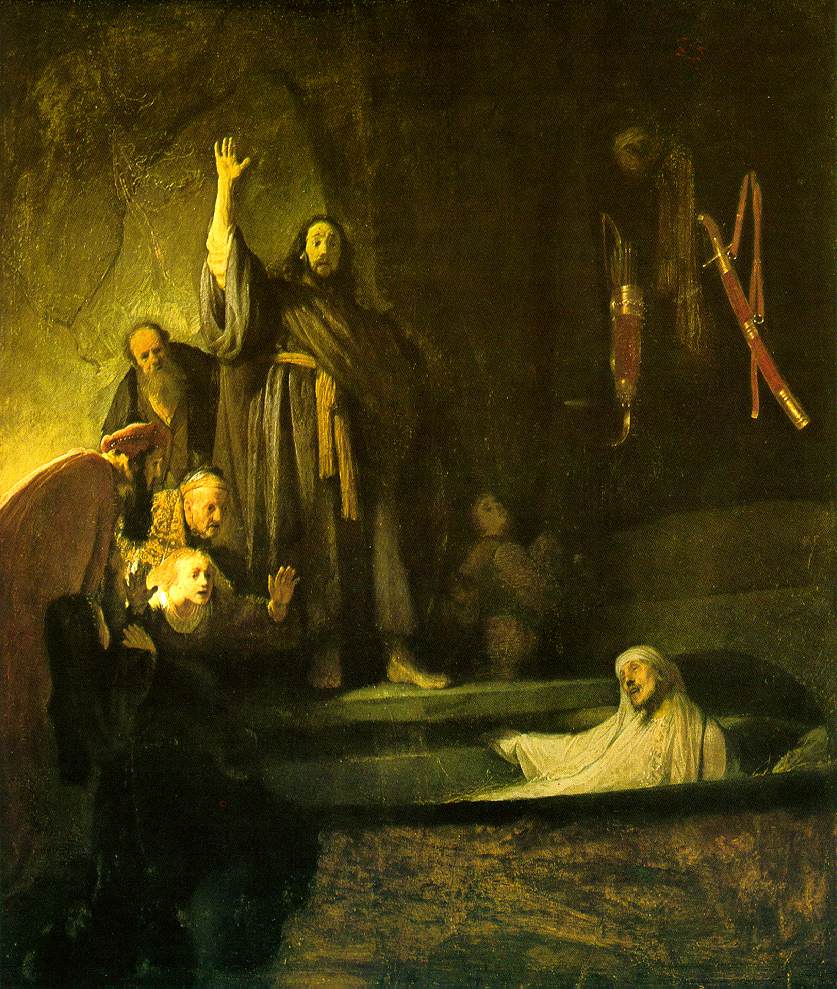
The Gospel According to Lazarus


Ben Witherington (Professor of New Testament Interpretation at Asbury Theological Seminary) has posted the text of a fascinating lecture he gave at the Society of Biblical Literature last November entitled "The Historical Figure of the Beloved Disciple in the Fourth Gospel."

In it he proposes the following scenario for the Gospel of John: it was based on the recollections and teaching of the "Beloved Disciple" who was the Lazarus whom Jesus raised in John 11. Lazarus and Mary and Martha (he argues) were the children of Simon the Leper (of Mark 14:3), and Lazarus himself may have also been leprous. The family was wealthy, probably a scion of a priestly family, and in any case known to the priests, despite the affliction of disease which made all three of the children unmarriageable.

Lazarus was a Judaean, not a Galileean, and is the reason for the fourth gospel's focus on Judaea, and the many other differences between the two. In the Upper Room discourses, Jesus reclined on the breast of "the Beloved Disciple" Lazarus, because Lazarus, as a Judaean, was actually the host, the main guest sat beside the host. Lazarus did not record the Gethsemane scene because he wasn't there, only Peter, and the sons of Zebedee, James and John, were. Although all the Galileean disciples fled during the crucifixion, Lazarus did not -- he was not scared of death any more! -- and so Jesus gave Mary into her care.

Naturally enough, the story arose in Christian circles that the Beloved Disciple Lazarus would not "fall asleep" a second time, that Jesus would come again before Lazarus suffered death a second time. When Lazarus died first, there was consternation. To address the Christian community and put the focus back on Jesus as the resurrection and the life John the Elder (not the son of Zebedee) then took Lazarus's recollections of Jesus's life and edited them as the Fourth Gospel. (Witherington believes his editorial role was minimal and that the voice of the Fourth Gospel is substantially that of Lazarus. He also contends that the "elder" of 2-3 John is Lazarus.)

Read the full post, and also the comments thread where many objections are raised by readers and addressed by Professor Witherington. It also turns out that the theory is not new, but is being advanced by him in a more thorough form than usual.

This theory will of course undergo rigorous sifting but it seems intriguing and very likely to be true as far as I can see as a mere Bible reader in translation.

Labels: ,

|

Monday, March 12, 2007

Jesus Before the Crucifixion and the Apostles after Pentecost: How Their Teachings Relate

Since the topic of the Gospels and Epistles came up below, I thought I'd see what the New Testament itself says about the issue. In fact I couldn't find anything using exactly those categories. What I could find a lot of, is commands, and references to the issue of the post-resurrection, post-Pentecost apostolic preaching relates to the pre-crucifixion teaching of the Lord. You could say it's a major theme, but I haven't seen much discussion of it. Since the Epistles are of course post-resurrection apostolic teaching and the Gospels transmit in retrospective form Jesus's pre-crucifixion teaching this is analogous to the distinction of Gospels and Epistles. Yet it's not exactly the same because, of course, the apostles actually wrote the gospels. In other words a skeptic could see it as circular: the apostles taking about in the voice of Jesus the teaching they will give in their own voice later. As every sensitive Bible reader notices, however, the Gospels do have a different voice from that of the Epistles, one in which Acts seems to be intermediate. (Just to take an example from the previous post, "Law and the Prophets" is common in the Gospels, sometimes found in Acts, and rare in the Epistles.)

Here is the teaching I've been able to glean

I. You Can't Hear the Lord without Hearing the Apostles.

The authority of the apostles is as the authority of Christ himself. After sending out the sevety-two, Jesus says (Luke 10):

The one who hears you hears me, and the one who rejects you rejects me, and the one who rejects me rejects him who sent me.

The same idea is expressed by Him at greater length in Matthew 10:

Whoever receives you receives me, and whoever receives me receives him who sent me. The one who receives a prophet because he is a prophet will receive a prophet's reward, and the one who receives a righteous person because he is a righteous person will receive a righteous person's reward.

II. The Pre-Crucifixion Teaching is Vivid and Intriguing but Cryptic, the Post-Pentecost Teaching Is Plain and Exhaustive:

This theme is emphasized in all three synoptics, whenever Jesus begins speaking in parables. After telling them the parable of the sower, the apostles ask (Mark 4, repeated in Luke 8 and Matthew 13):

And when he was alone, those around him with the twelve asked him about the parables. And he said to them, "To you has been given the secret of the kingdom of God, but for those outside everything is in parables, so that

"they may indeed see but not perceive,
and may indeed hear but not understand,
lest they should turn and be forgiven."

And he said to them, "Do you not understand this parable? How then will you understand all the parables? The sower sows the word. . . .

He explains the parable of the sower, the lamp under a basket, the growing seed, and the mustard seed, and then concludes again:

With many such parables he spoke the word to them, as they were able to hear it. He did not speak to them without a parable, but privately to his own disciples he explained everything.

From Jesus's advice and warnings to the apostles we read this passage, where Jesus takes what is elsewhere a purely apocalyptic saying and uses it to contrast the pre-crucifixion and the post-resurrection teaching (Matthew 10):

So have no fear of them, for nothing is covered that will not be revealed, or hidden that will not be known. What I tell you in the dark, say in the light, and what you hear whispered, proclaim on the housetops. And do not fear those who kill the body but cannot kill the soul. Rather fear him who can destroy both soul and body in hell.

In Luke 12, we see Jesus giving this saying a purely apocalyptic sense: what Jesus and the apostles say in secret will be revealed on the Last Day to justify God's judgments.

That the post-Pentecost teaching will be more thorough and exhaustive than that during Jesus's life emerges in Jesus's upper room discourse recorded in John's gospel (John 16):

"I still have many things to say to you, but you cannot bear them now. When the Spirit of truth comes, he will guide you into all the truth, for he will not speak on his own authority, but whatever he hears he will speak, and he will declare to you the things that are to come. He will glorify me, for he will take what is mine and declare it to you."

What are these things that the Holy Spirit will declare to the apostles? For starters, I would expect it to be the sermons of Acts and the texts of the Epistles and the Apocalypse.

III. The Pre-Crucifixion Teaching Was Discrete on Certain Topics, but the Post-Resurrection Teaching Avoids No Sensitive Topic.

Sometimes the apostles were directly commanded not to speak until after the resurrection. This occurred after Peter's confession (Mark 8; cf. Matthew 16, Luke 9):

And he asked them, "But who do you say that I am?" Peter answered him, "You are the Christ." And he strictly charged them to tell no one about him.

And after the transfiguration (Mark 9; cf. Matthew 17):

And as they were coming down the mountain, he charged them to tell no one what they had seen, until the Son of Man had risen from the dead.

IV. The Full Implications of the Pre-Crucifixion Teachings Were Not Understood by the Apostles Until After the Resurrection.

There are a number of passages in which the apostles are said to have only understood what Jesus said after His resurrection. For example, it is implied that the apostles only understood after the resurrection in the telling of the first miracle of the loaves and the walking on water (Mark 6; cf. the leaven of the Pharisees section in Mark 8 and Matthew 16):

When they saw him walking on the sea they thought it was a ghost, and cried out, for they all saw him and were terrified. But immediately he spoke to them and said, "Take heart; it is I. Do not be afraid." And he got into the boat with them, and the wind ceased. And they were utterly astounded, for they did not understand about the loaves, but their hearts were hardened.

That they did not understand is repeated right after the Transfiguration (Mark 8; cf. Luke 9)

They went on from there and passed through Galilee. And he did not want anyone to know, for he was teaching his disciples, saying to them, "The Son of Man is going to be delivered into the hands of men, and they will kill him. And when he is killed, after three days he will rise." But they did not understand the saying, and were afraid to ask him.

This is mentioned many times in the gospel of John, as in the cleansing of the temple (John 2):

And making a whip of cords, he drove them all out of the temple, with the sheep and oxen. And he poured out the coins of the money-changers and overturned their tables. And he told those who sold the pigeons, "Take these things away; do not make my Father's house a house of trade." His disciples remembered that it was written, "Zeal for your house will consume me."

So the Jews said to him, "What sign do you show us for doing these things?" Jesus answered them, "Destroy this temple, and in three days I will raise it up." The Jews then said, "It has taken forty-six years to build this temple, and will you raise it up in three days?" But he was speaking about the temple of his body. When therefore he was raised from the dead, his disciples remembered that he had said this, and they believed the Scripture and the word that Jesus had spoken.

For example, the triumphal entry (John 12):

And Jesus found a young donkey and sat on it, just as it is written,

"Fear not, daughter of Zion;
behold, your king is coming,
sitting on a donkey's colt!"

His disciples did not understand these things at first, but when Jesus was glorified, then they remembered that these things had been written about him and had been done to him.

Even on Easter morning (John 20)

Then the other disciple, who had reached the tomb first, also went in, and he saw and believed; for as yet they did not understand the Scripture, that he must rise from the dead. Then the disciples went back to their homes.

Hermeneutically, this is a somewhat tricky category. We read the teachings of Jesus as recorded by men who tell us that at the time they didn't understand them, but now they do. So in their re-telling are they doing it from the first, "didn't understand" perspective, or from the post-resurrection "now I understand!" perspective? Certainly as I said, you can see the substantial difference in tone between the words of Jesus and of the Epistles as evidence that the apostles were quite successful in maintaining the integrity of the pre-crucifixion teachings.

In the following passage from Mark 7, we can see all three levels at work: a parabolic saying not understood by the crowd, a teaching for the apostles which must prudently be left silent for the time being, and a the clear-cut understanding of it which is undoubtedly post-resurrection:

And he called the people to him again and said to them, "Hear me, all of you, and understand: There is nothing outside a person that by going into him can defile him, but the things that come out of a person are what defile him." And when he had entered the house and left the people, his disciples asked him about the parable. And he said to them, "Then are you also without understanding? Do you not see that whatever goes into a person from outside cannot defile him, since it enters not his heart but his stomach, and is expelled?" (Thus he declared all foods clean.)

At first we have a parable. Jesus explains it to the apostles. Yet the topic of the parables is the cancellation of the law of Moses, which led to Stephen's martyrdom in Acts. Did the apostles understand even then? The final comment has the air of a commentary, inserted by the post-resurrection evangelist, which is why the translators put it in parentheses.

V. The Post-Pentecost Teaching Explicitly Shows How the Old Testament Is Fulfilled in the New:

Finally, as several of the previous examples showed, a good deal of the the post-resurrection understanding was realizing how the Hebrew scriptures was fulfilled in the life of Jesus and the church. According to Luke, this was the main topic of Jesus's post-Resurrection discourses (Luke 24):

And he said to them, "O foolish ones, and slow of heart to believe all that the prophets have spoken! Was it not necessary that the Christ should suffer these things and enter into his glory?" And beginning with Moses and all the Prophets, he interpreted to them in all the Scriptures the things concerning himself. . . .

And their eyes were opened, and they recognized him. And he vanished from their sight. They said to each other, "Did not our hearts burn within us while he talked to us on the road, while he opened to us the Scriptures?" . . . .

Then he said to them, "These are my words that I spoke to you while I was still with you, that everything written about me in the Law of Moses and the Prophets and the Psalms must be fulfilled." Then he opened their minds to understand the Scriptures, and said to them, "Thus it is written, that the Christ should suffer and on the third day rise from the dead, and that repentance and forgiveness of sins should be proclaimed in his name to all nations, beginning from Jerusalem. You are witnesses of these things. And behold, I am sending the promise of my Father upon you. But stay in the city until you are clothed with power from on high."

It might seem tantalizing that none of these words were written down. How tragic to have lost these teachings! But were they lost? Leaving them unmentioned, Luke sets up in the reader a desire to understand these words. And what follows? The sermons recorded in Acts which are full of explanations of how the Old Testament is fulfilled in the new. And what is not in those was presumably taught by the apostles, directly or indirectly, in the Epistles. As I remember hearing in a Bible study, one Biblical commentator has said that Paul's Epistle to the Romans can be read as an essay on interpreting the Hebrew Bible as the Old Testament. There is no reason to believe that the much, or indeed anything, of these teachings were lost.

The peculiar thing about all this is that Jesus's teachings are honored as being the best teaching despite being explicitly described as cryptic to the point of misleading, occasionally silent on crucial issues, hard to understand, and lacking Old Testament verification. They weren't intended to remain so; indeed the Gospels once written mix both the pre-crucifixion text and the post-Pentecost understanding. But they still retain something of their cryptic, gnomic, discrete, and self-authenticating character compared to the Epistles. I don't think there is any other conclusion that can be drawn but that these things are to be honored; that cryptic, gnomic, discrete, and self-authenticating teaching that causes the hearers to wonder more than they (at first) understand is the mark of a truly divine teaching. Of course this is what the Gospels themselves say (Mark 1:22; note how John 8:28 unpacks the significance of this):

And they were astonished at his teaching, for he taught them as one who had authority, and not as the scribes.

Labels: , ,

|